


Updated Feb-2022 Pass L4M5 Exam - Real Practice Test Questions
Download Free CIPS L4M5 Real Exam Questions
NEW QUESTION 72
Ma Bell was the sole provider of landline telephoneservice to most of the US in 1980s. This is an example of...?
- A. Monopolistic competition
- B. Monopsony
- C. Monopoly
- D. Perfect competition
Answer: C
Explanation:
Explanation
A monopoly exists when only one company can supply an essential product or service in a givenregion because of significant barriers to entry for any competitor. The barriers can be legal, regulatory, economic, or geographic. Ma Bell case is an example of monopoly. The company was broken up in 1982.
A monopsony is a market structure in which a single buyer substantially controls the market as the major purchaser of goods and services offered by many would-be sellers.
Pure or perfect competition is a theoretical market structure in which the following criteria are met:
- All firms sell an identical product (the product is a "commodity" or "homogeneous").
- All firms are price takers (they cannot influence the market price of their product).
- Market share has no influence on prices.
- Buyers have complete or "perfect" information-in the past, presentand future-about the product being sold and the prices charged by each firm.
- Resources for such a labor are perfectly mobile.
- Firms can enter or exit the market without cost.
Monopolistic competition characterizes an industry in which many firms offerproducts or services that are similar, but not perfect substitutes. Barriers to entry and exit in a monopolistic competitive industry are low, and the decisions of any one firm do not directly affect those of its competitors. Monopolistic competition is closely related to the business strategy of brand differentiation
NEW QUESTION 73
When is the best time for buyer to propose the negotiation agenda to potential supplier?
- A. At preparation stage
- B. Atconclusion stage
- C. At testing stage
- D. At opening stage
Answer: A
Explanation:
A business negotiation agenda is a formal agreed upon list of goals to be achieved or items to be discussed in a particular order during a meeting or negotiation. Agendascan be formal and obvious, or informal and subtle in negotiations.
The agenda is one of the main structural elements of negotiation, in addition to such questions as site, identification of participants, and elements of timing. Together, they answer the who, what, when, and where questions. As with other aspects of negotiation, the agenda can be used either manipulatively to enhance leverage or to improve the prospects for agreement and the possibilities for mutual gain. In most cases, it will be used bothways, reflecting the nature of negotiation as a "mixed-motive" situation.
Although it can be instrumental to [research] volunteer as a sole source to write the agenda, in most cases it becomes a joint activity to construct a consensual basis for subsequent negotiation. In these situations, agenda-building becomes one of the pre-negotiation activities that set the tone for the relationship (Saunders,
1985). In other situations, the parties may engage in actual negotiation without a formal or written agenda.When this occurs, the risks and uncertainties may be high but the party who appreciates the importance of the informal agenda has a tremendous advantage.
Whether one plans it or not, during the course of negotiation the parties will discuss a finite set of issues in some sequence and from a particular perceptual framework. Consciousness of the universality and centrality of the agenda is prerequisite to guiding negotiation to a successful conclusion.
NEW QUESTION 74
Which of the following will help to indicate personality preferences in four dimensions?
- A. Intelligence quotient
- B. Myers-Briggs Type Indicator
- C. Thomas-Kilmann Conflict Resolution model
- D. Mill's RESPECT mnemonic
Answer: B
Explanation:
The Myers-Briggs Type Indicator (MBTI) is an introspective self-report questionnaire indicating differing psychological preferences in how people perceive the world and make decisions. MBTI indicates personality preferences in four dimensions.
The Thomas-Kilmann Conflict Mode Instrument (TKI) is a conflict style inventory, which is a tool developed to measure an individual's response to conflict situations.
Mill's RESPECT mnemonic is set out by Harry A. Mills which describes seven steps to agreements An intelligence quotient (IQ) is a total score derived from a set of standardized tests designed to assess human intelligence.
NEW QUESTION 75
Which of the following best describes Leverage quadrant in Kraljicmatrix?
- A. High value, high complex
- B. High complex, low importance
- C. Low risk, low importance
- D. Low risk, high importance
Answer: D
Explanation:
Explanation
In 1983, Peter Kraljic devised a means to segment the supplier base in the article in HBR. In this, heargued that supply items should be mapped against two key dimensions: risk and profitability.
Risk relates to the likelihood for an unexpected event in the supply chains to disrupt operations. For instance, in important areas of spend, such as tire suppliers for an automotive are business critical, and should a disruption occur, the auto company is likely itself to face substantial problems.
Profitability describes the impact of a supply item upon the bottom line. For certain areas of spend, such as stationery, supplies have only a negligible effect on profits. In other categories, a single source of supply can make or break a business.
Putting these two dimensions together yields a classic two-by-two matrix.
Diagram Description automatically generated
Source: Peter Kraljic, HBR
NEW QUESTION 76
A buying organisation with a low spend and the reputation for paying late might be viewed by a supplier as which of the following?
- A. Nuisance
- B. Develop
- C. Exploit
- D. Core
Answer: A
Explanation:
To answer this question, you should know The seller's perspective as in 'How to Negotiate Professionally':
Chart, treemap chart Description automatically generated
In the scenario, the buyer's spend is low, while they seem unattractive to seller (as they tend to pay late). So the buyer is classified as Nuisance in seller's perspective.
NEW QUESTION 77
Which of the following are most likely to turn buying organisation into an unattractive customer in supplier's perspective? Select TWO that apply.
- A. Using SRM technology
- B. Adopting clear and concise CSR policies
- C. Unclear tender award criteria
- D. Demands for kickback
- E. Reduced paperwork in procurement processes
Answer: C,D
Explanation:
Becoming a preferred customerto supplier's perspective can increase the purchaser's leverage in negotiation.
Beside the size of buying organisation or its spend, the following may be sufficient to differentiate the buyer from other buying organisations:
Simple procurement processes: Using SRM technology may help to simplify the process Simple contracting processes Clear and concise documentation: Reduced paperwork helps both supplier and buyer save their time and resources.
Absence of onerous supplier terms and conditions
On-time payment
Transparent processes: Unclear tender award criteria can be seen as opaque. Suppliers who attended the tendering processes cannot know the reasons why their bids are rejected and hesitate to attend other tendering.
Ethical behaviour: Suppliers may prefer a buyer who adopts CSR policy because they can predict potential customer's behaviour. Demands for kickback are unethical behaviours.
NEW QUESTION 78
'What specific tests do you carry out to ensure quality is achieved?' This is an example of which type of negotiation question?
- A. Reflective
- B. Closed
- C. Leading
- D. Probing
Answer: D
Explanation:
Explanation
The question requires more detailed answer, it is an example of probing question.
Probing questions are typically follow-up questions, and aim to elicit more detailed information on the back of the answer elicited from theopen questions. Probing question are also useful to check that the supplier fully understand their offering, as well as your needs, can also be used to communicate to the suppliers that you know this category well.
LO 3, AC 3.3
NEW QUESTION 79
Which of the following is NOT a barrier to entry in amonopolized market?
- A. A single firm is very large
- B. The government gives a single firm the exclusive right to produce some good
- C. The costs of production make a single producer more efficient than a large number of producers
- D. A key resource is owned by a single firm
Answer: A
Explanation:
Monopolies exist in many markets in real life for very different reasons:
Ownership of a Key Resource: When one company exerts sole control over a resource that is necessary for the production of a specific product,the market may become a monopoly. For example, the only medication deemed acceptable to treat a disease comes from a particular ingredient X, and knowledge of this ingredient X is owned by a single family owned company. The company can, therefore, be saidto have a monopoly over ingredient X that is needed to cure the disease because it is the only company that can produce a product deemed acceptable.
Government Franchise: In certain instances, a monopoly may be explicitly created by the government if it grants a single company, whether private or government-owned, the right to conduct business in a particular market. For example, when a national railways transportation service is created by the government, in most cases they are granted a monopoly on the operation of passenger trains in the country. As a result, other firms are only able to offer passenger train services with the cooperation and/or permission of the government-owned provider.
Intellectual Property Protection: Extending intellectual propertyprotection to a company in the form of patents and copyrights is yet another way in which monopolies are created. When a government does this, it is in fact giving a single company an exclusive right to provide a particular product / service to the market. Patents and copyrights work in providing owners of intellectual property with the right to act as an exclusive provider of a new product for a specific length of time. This creates a temporary monopoly in the market with regards to new products and services.
Natural Monopoly: A market may also become a monopoly simply because it may be more cost-effective for one company to serve the whole market than to have several smaller firms in competition with one another. A company with virtually unlimited economies of scale is referred to as a natural monopoly. Such firms become monopolies due to their position and size, which makes it impossible for new entrants in the market to compete price-wise. Natural monopolies are common in industries with high fixed costsand low marginal costs of operation such as providers of television, telephone, and internet services.
In this question, 'A single firm is very large' is not enough to tell whether this market is monopolistic.
NEW QUESTION 80
Which of the following are most likely to be fundamentals of Fisher & Ury's principled negotiation?
1. Depersonalise the argument
2. Focuson positions
3. Generate creative options
4. Using subjective criteria
- A. 2 and 3 only
- B. 1 and 3 only
- C. 1 and 4 only
- D. 2 and 4 only
Answer: B
Explanation:
Explanation
Principled negotiation is based on four fundamentals: people, interest, options andcriteria: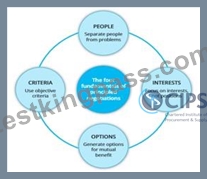
Diagram Description automatically generated
1st Principle: separate the people from the problem: Negotiator should depersonalise the situation and accepting that the subject matter of the negotiation. This can be difficult for untrained negotiators, but this is a key skill to develop
2ndprinciple: focus on interests, not positions: It is important in principled negotiations not to focus on their parties' positions (what are expressed during negotiations), but on the interests (underlying needs) behind them
3rd principle: invent options for mutual gains: this principle aims to help the parties find a solution that both would benefit from. The more options - or tradeables - that can be brought to the table the better.
4th principle: insist on using objective criteria: is about making sure that the negotiation stays focused on outcomes based on objective criteria and that it is productive.
LO 1, AC 1.2
NEW QUESTION 81
Where can we find the data on macroeconomics?
1. From trade journal
2. From supplier's marketing catalogue
3. From stock exchange market
4. From government's statistics
- A. 3 and 4 only
- B. 1 and 2 only
- C. 1 and 3 only
- D. 2 and 4 only
Answer: A
Explanation:
Explanation
Macroeconomic indicators are statistics or data readings that reflect the economic circumstances of a particular country, region or sector. They are used by analysts and governments to assess the current and future health of the economy and financial markets.
Macroeconomic indicators will vary in their meaning and the impact that they have on the economy, but broadly speaking there are two main types of indicator.
- Leading indicators, which forecast where an economy might be heading. They are often used by governments to implement policies because they represent the first phase of a new economic cycle. These include the yield curve, interest rates and share prices.
- Lagging indicators, which reflect an economy's historical performance and only change after a trend has been established. They are used to confirm a trend is underway. These include gross domestic product (GDP), inflation and employment figures.
There is also the category of coincident indicators, but these are generally grouped in with lagging indicators as they either happen at the same time or after an economic shift.
The best macroeconomic indicator to watch will heavily depend on your personal preferences, what positions you are taking and which country your portfolio is focused on. However, there are some very common indicators that most traders and investors will keep an eye on.
For simplicity's sake, we have split these out into leading and lagging indicators.
Top leading indicators:
1. The stock market
2. House prices
3. Bond yields
4. Production and manufacturing statistics
5. Retail sales
6. Interest rates
Top laggingindicators:
1. GDP growth rates
2. The Consumer Price Index (CPI) and inflation
3. Currency strength and stability
4. Labour market statistics
5. Commodity prices
A procurement professional may find stock market data from the security exchange, whilemost lagging indicators (such as GDP, CPI, unemployment rate, currency and inflation rate, etc) can be found from government statistics data.
NEW QUESTION 82
Which of the following are most likely to help buyer become preferred customer in supplier's perspective?
Select TWO that apply.
- A. Shorter payment period
- B. Compliance with agreed repair lead time
- C. Reduction in delivery errors
- D. Ensuring an increased number of repeat orders
- E. Onerous supplier terms and conditions
Answer: A,D
Explanation:
Explanation
Becoming a preferred customer to supplier's perspective can increase the purchaser's leverage in negotiation.
Beside the size of buying organisation or its spend, the following may be sufficient to differentiate the buyer from other buying organisations:
- Simple procurement processes
- Simple contracting processes
- Clear and concise documentation
- Absence of onerous supplier terms and conditions (onerous supplier terms and conditions mean that obligations imposed on suppliers are greater than their gains)
- On-time payment: The reduction in hassle for both supplier and the buyer, if bills are paid on time, is significant. From the customer's perspective it could also be the opener to agreeing preferential payment terms. A supplier may weigh up that payment on time at 60 days is worth taking, over the current 30-day terms that slip to 90 days and beyond.
-Transparent processes
- Ethical behavior
LO 1, AC 1.3
NEW QUESTION 83
Active listening in negotiation includes which of the following activities?
1. Hearing
2. Interpreting
3. Rapport
4. Influence
- A. 1 and 3 only
- B. 2 and 3 only
- C. 3 and 4 only
- D. 1 and 2 only
Answer: D
Explanation:
Explanation
Listening is a hugely important skill in the world of work. It's a key part of effective communication [...].
Regarding active listening, there is a model called 'The SIER Hierarchy of Active Listening'. It details four key stages required for effective listening. As with all models associated with active listening, its purpose is to help the listener be a better, more effective listener who really hears what is being said, connects with the individual with whom they are communicating andbuilds effective relationships.
The model is a hierarchical model meaning that each stage builds on the stage before it. While the model is sometimes used for training in the sales arena, it is helpful in all walks of life. The stages of the model are:
Sensing (including hearing and watching body language), Interpreting, Evaluating and Responding.
Text Description automatically generated with low confidence
NEW QUESTION 84
Which of the following is the internal factor that is taken intoprice of a product?
- A. Elasticity
- B. Customer tastes
- C. Exchange rate
- D. Risk management
Answer: D
Explanation:
Explanation
In order to answer this question, you should better consider each option:
'Exchange rate' is the value of one nation's currency versus thecurrency of another nation or economic zone.
This is a macroeconomic factor.
'Elasticity' refers to the degree to which individuals, consumers or producers change their demand or the amount supplied in response to price or income changes. This is a microeconomic factor Consumer tastes refer to the products and services that consumers consciously choose over others. Consumer tastes are so powerful that they can change how businesses conduct their activity. Like elasticity, this is also a microeconomic factor.
Among 4 options, only risk management is the internal factor. Risk pricing is a strategy applied by many companies in the world. To learn how to price the risk, you can read an article from McKinsey:
https://www.mckinsey.com/business-functions/marketing-and-sales/our-insights/how-to-price-risk-to-win-and-pr This is a question that a student met in her actual exam. The knowledge section is unknown.
LO: Unknown, AC: Unknown
NEW QUESTION 85
Which of thefollowing are signs indicating that TOP is using coercive power in commercial negotiation?
Select TWO that apply.
- A. Withdrawal of benefits
- B. Technical expertise
- C. Demonstrating fairness and respect
- D. Positive references
- E. Use of guilt
Answer: A,E
Explanation:
Coercive power comes from the belief that a person can punish other for non-compliance, and can be considered as the flip side of reward power. Coercive power rests in the individual's ability to change other people's behaviour through threat,intimidation, use of guilt, ability to embarrass or shame, or withdrawal of benefits,...
NEW QUESTION 86
Which of the following are factors that might shift the demand curve for a consumer good to the right?
1. Prices of complementary goods decrease
2. Price of the consumer good decreases
3. Customers' expectation of higher prices in the future
4. Consumer tastes shift toward substitute products
- A. 1 and 2 only
- B. 4 and 2 only
- C. 3 and 4 only
- D. 1 and 3 only
Answer: D
Explanation:
Explanation
A shift in demand occurs when an influencing factor other than price changes. Those factors are:
- The income ofbuyers
- The tastes and preferences of buyers
- The prices of other goods and services, especially substitutes and complements
- Expectations of buyer about the future
In this question:
- 'Prices of complementary goods decrease' will lead toquantity demanded for that complements rising, then demand for consumer good will increase accordingly.
- 'Price of the consumer good decreases' will increase the quantity demanded for that good, but it will not shift the demand curve
- 'Customers' expectation of higher prices in the future': in this scenario, customers tend to buy more to store in present, which leads to demand curve shifting to the right
- 'Consumer tastes shift toward substitute products': Demand for substitutes will rise, so demand forthat consumer good will decrease and the demand curve shifts to the left.
LO 2, AC 2.2
NEW QUESTION 87
......
CIPS L4M5 Exam Syllabus Topics:
| Topic | Details |
|---|---|
| Topic 1 |
|
| Topic 2 |
|
| Topic 3 |
|
| Topic 4 |
|
| Topic 5 |
|
| Topic 6 |
|
| Topic 7 |
|
| Topic 8 |
|
L4M5 Dumps 100 Pass Guarantee With Latest Demo: https://www.testkingpass.com/L4M5-testking-dumps.html
Pass Your Exam With 100% Verified L4M5 Exam Questions: https://drive.google.com/open?id=1er-q3f2DRaqLl0RUfWJUDwD4p_3T6drR