


2023 Updated Verified Pass L4M5 Study Guides & Best Courses
Ultimate Guide to the L4M5 - Latest Edition Available Now
CIPS L4M5 Certification Exam covers a range of skills and knowledge areas related to commercial negotiation. These include understanding the principles of effective negotiation, developing negotiation strategies, managing the negotiation process, and analyzing and evaluating negotiation outcomes. L4M5 exam is designed to test candidates' knowledge of these areas and their ability to apply this knowledge in real-world situations.
Upon successful completion of the CIPS L4M5 Exam, candidates will receive a globally recognized certification that demonstrates their expertise in commercial negotiation. This qualification can open up new career opportunities in procurement and supply chain management, and enable individuals to progress to higher levels of the CIPS program.
NEW QUESTION # 85
Commercial negotiation ends at the award of a contract. Is this statement true?
- A. Yes, because there are no rooms for negotiation after the contract is awarded
- B. No, because real commercial negotiation begins after the contract is awarded
- C. Yes, because the supplier will comply with legally binding obligations
- D. No, because improvements can be achieved through post-award negotiation
Answer: D
Explanation:
Explanation
Negotiation doesn't end after the contract is awarded. The needs for negotiation can arise in anypost-award stages. For example, at supplier development and relationship management stage, improvement in supplier capability, capacity, and product/service range can be negotiated. Negotiations with long-term strategic critical suppliers should be carriedout in a partnering style, with a win-win starting point assumed.
In some sectors such as transport, utilities and infrastructure, tenderers may 'bid low' or even make a loss to win major contracts with a view to negotiating lucrative changes, variationsand 'add-ons' over the life of the contract when the supplier is bedded in and the buyer is in the weaker position to push back or challenge. Even in less complex contract, it is very likely that there will be a need to negotiate with that supplier again after the awarding of the contract.
LO 1, AC 1.1
NEW QUESTION # 86
Which of thefollowing are signs indicating that TOP is using coercive power in commercial negotiation?
Select TWO that apply.
- A. Use of guilt
- B. Technical expertise
- C. Demonstrating fairness and respect
- D. Positive references
- E. Withdrawal of benefits
Answer: A,E
Explanation:
Coercive power comes from the belief that a person can punish other for non-compliance, and can be considered as the flip side of reward power. Coercive power rests in the individual's ability to change other people's behaviour through threat,intimidation, use of guilt, ability to embarrass or shame, or withdrawal of benefits,...
NEW QUESTION # 87
Which of the following are most likely to be macro factorsthat may influence the balance of power in commercial negotiation? Select THREE that apply.
- A. Intensity of competition in a industry
- B. Number of substitute products or services
- C. Sustainability of natural resources
- D. Purchasing spend volume
- E. Disruptive technologies
- F. Economic growth rates
Answer: C,E,F
Explanation:
Explanation
All one-to-one commercial negotiations between a specific purchaser and a specific supplier take place within an industrial market and a larger business environment characterised by multiple forces which both parties typically have little control over. STEEPLE framework highlights the 6 main external influences on a business:
Table Description automatically generated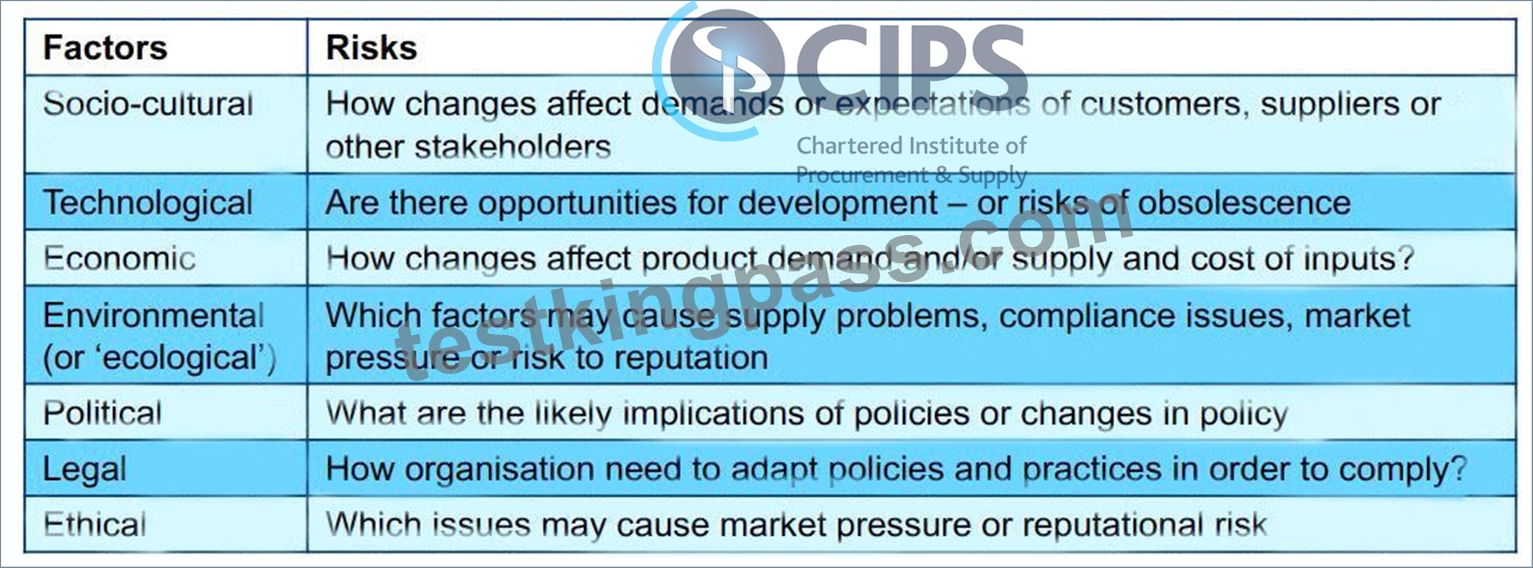
LO 1, AC 1.3
NEW QUESTION # 88
Which of the following is the area where two or more negotiating parties may find common ground?
- A. Walk away area
- B. Zone of proximal development
- C. Zone of potential agreement
- D. Best alternative to a negotiated agreement
Answer: C
Explanation:
Explanation
The zone of possible agreement (ZOPA) orbargaining range is considered an area where two or more negotiating parties may find common ground. It is this area where parties will often compromise and strike a deal. In order for negotiating parties to find a settlement or reach an agreement, they must work towards a common goal and seek an area that incorporates at least some of each party's ideas.
The zone of proximal development refers to the difference between what a learner can do without help and what he or she can achieve with guidance and encouragement from a skilled partner.
There is no Walk away area. Walk away point is a position from which you cannot concede any more ground and must walk away/decline a deal.
Best alternative to a negotiated agreement is a fallback or backstop position if the negotiation fails to result in an agreement/no deal is agreed.
LO 1, AC 1.2
NEW QUESTION # 89
During a negotiation, the supplier requests for payment term shortened to 45days from 60 days. Seeing that this proposal lies within the concession plan, the procurement manager asks for 5% discount in return. Is that right thing to do?
- A. No, it is unethical to exploit the weakness of the other party
- B. Yes, the procurement manager should keep that 5% for himself because that amount is a fair compensation for his effort
- C. No, procurement should insist the payment term remains 60 days
- D. Yes, since procurement manager has his own cost savings target to achieve and he should make use of supplier's financial status
Answer: D
Explanation:
Explanation
When preparing for a negotiation, negotiator should establish a list of tradeables and a concession plan. Good negotiators never give anything away that has not already been planned as part of the bargaining mix in the concession planning stage.
In the above scenario, the procurement manager has planned his own concession, so he can trade with supplier. The answer should be "Yes, since procurement manager has his own cost savings target to achieve and he should make use of supplier's financial status" Table Description automatically generated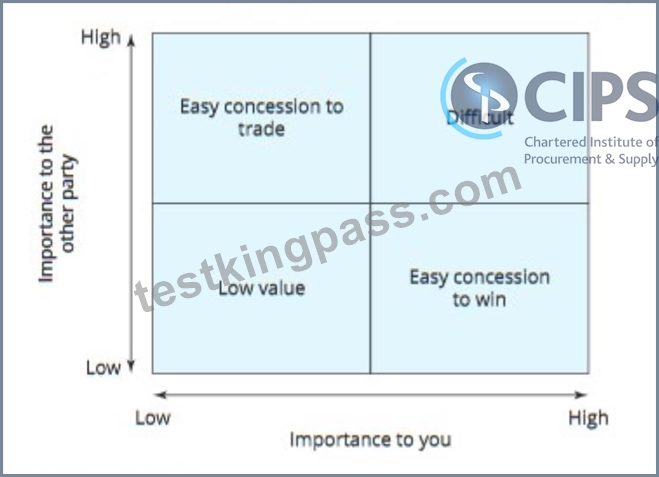
LO 2, AC 2.3
NEW QUESTION # 90
Which of thefollowing are most likely to be sources of conflict that can emerge from the content of commercial negotiations? Select TWO that apply.
- A. Framework arrangement
- B. Requisition
- C. Contract governing law
- D. Payment terms
- E. Cultural differences
Answer: C,D
Explanation:
Explanation
There are multiple sources of divergent positions that can arise in situations where money is exchange for goods and services. There are 2 different types of sources. Those that arise from the content or subject matter of the negotiation (what is being negotiated) and those that arise from the process of negotiation (how it is being negotiated).
Sources of divergent position - the content of negotiation:
Table Description automatically generated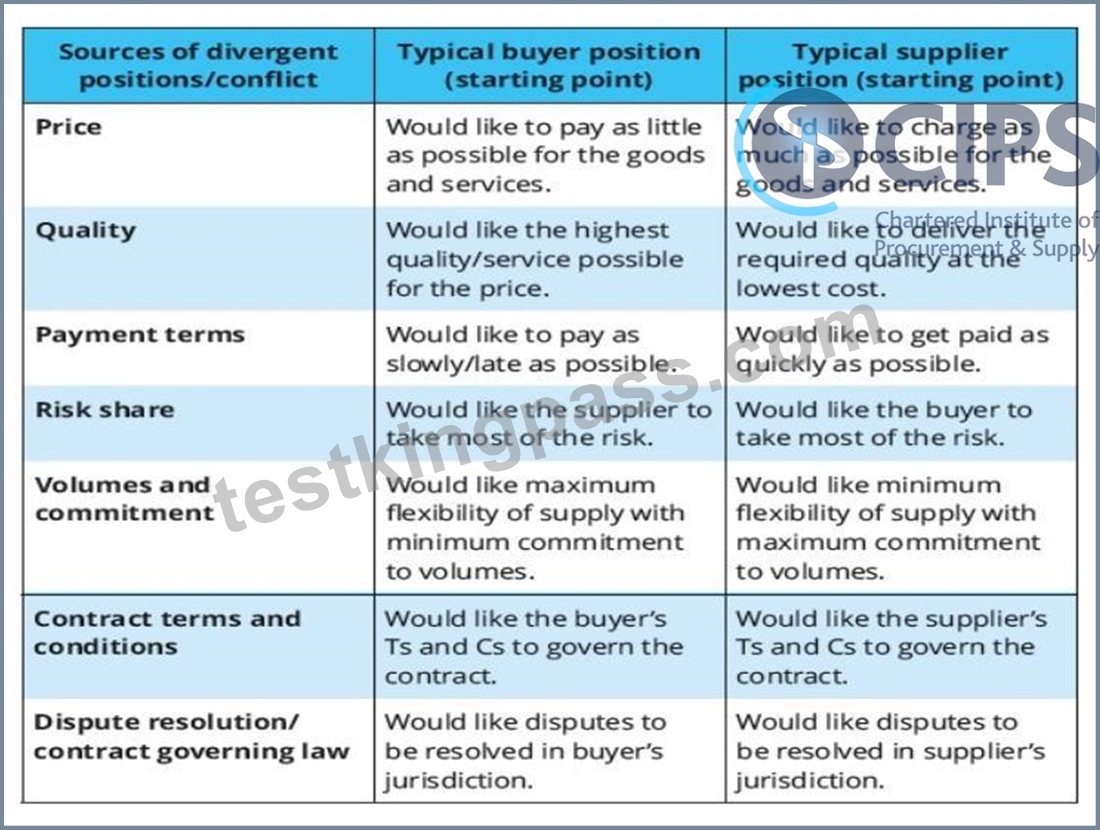
Cultural differences are the source of conflict in the process of negotiation.
Requisition is an internal document raised by user or store to communicate to procurement the need to buy the product or service specified. This is merely a internal document.
Framework arrangement is a rather loose set-up, without any legal standing. It usually occurs when an organisation has decided for itself to limit the number of suppliers it is willing to work with and, through a purely internal process, sets up an approved list of such suppliers.
LO 1, AC 1.1
NEW QUESTION # 91
Which of the following is definition of elasticity of demand in microeconomics?
- A. The percentagechange in income divided by the percentage change in the quantity demanded
- B. Thepercentage change in price of a good divided by the percentage change in the quantity demanded of that good.
- C. The percentage change in the quantity demanded of a good divided by the percentage change in the price of that good
- D. The percentage change in the quantity demanded divided by the percentage change in income
Answer: C
Explanation:
Elasticity refers to the responsiveness of quantity demanded or quantity supplied to a change in price or another factor:
The price of a product can be described as being elastic if a small change in price leads to a big change in demand.
The price of a product can be described as being inelastic if a big change in price leads to a small change in demand.
The formulae of elasticity of demand is known as the following:
Text Description automatically generated with low confidence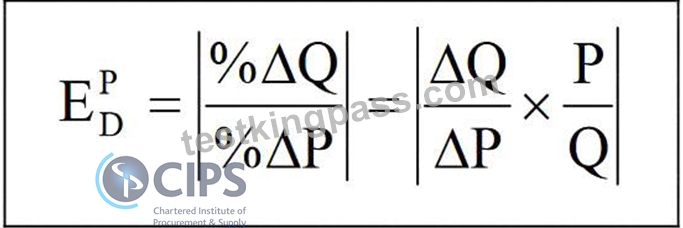
NEW QUESTION # 92
Which of the following will positively affect reputational strength of an organisation? Select TWO that apply.
- A. Strong customer focus
- B. Great gap between reputation and reality
- C. Weak internal coordination
- D. High ethical standards
- E. Adopting out-of-date technology
Answer: A,D
Explanation:
Explanation
In a globalisedcommercial world characterised by dynamic market and multiple companies competing for business, a positive corporate reputation can be an enormous asset. Reputational strength in one organisation might be based on some or all of the following characteristics:
- Quality of products or services
- Low cost/high value for money
- High ethical standards
- Reliability
- Cutting-edge technology
- Strong customer focus
- Engineering excellence
LO 1, AC 1.4
NEW QUESTION # 93
XYZ Ltd decides to go to market for a cleaning contract to service a number of offices. It knows that it will get a price which may, ormay not, be better than the one it is currently paying. To gain leverage in the marketplace, the organisation decides to add other related services to the scope, such as gardening, security and maintenance, which increase the value of the contract. This is an example of which forms of spend consolidation?
- A. Purchasing consortia
- B. Volume redistribution
- C. Volume consolidation across categories
- D. Volume pooling
Answer: C
Explanation:
Explanation
Buying organisation may increase its leverage with suppliers byconcentrating spend. Supplier spend consolidation can take many forms as outlined below:
- Vendor base reduction: straightforward reduction of number of suppliers in any category
- Volume pooling: pooling cross organisational requirement until your order volume is high enough to attract new bidders/additional discounts
- Volume redistribution: making recommendations following spend analysis to move from one supplier to another
- Volume consolidation across categories: certain purchase requirements may be common across a number of categories. In the scenario, XYZ has combined different categories but closely related to office services into a larger contract so that they can increase their leverage.
- Standardisation and harmonisation of specifications: analysis of specifications and standards for a high spend purchased input, may show that there is a little difference between them and that the specification can be standardised or at least harmonised across the group or across national, regional or global operations.
- Forming purchasing consortia: buyers may decide to come together and combine their purchase volumes to attract better deals.
LO 1, AC 1.3
NEW QUESTION # 94
Which of the following can help both parties to break the vicious cycle of blame when a relationship needs repairing? Select TWO that apply.
- A. Conflict management skills
- B. Constant shadowing and oversights
- C. Emotional-based assessment
- D. Both parties understand each other's goals
- E. Focusing onpositions
Answer: A,D
Explanation:
In order to break vicious cycle of blame, procurement will need to use their negotiation and conflict management skills,adopting a collaborative and integrative approach. Your first action should be to establish the facts that led to the situation where the relationship broke down. Most day-to-day relationship between buying organisations and suppliers do not of course involve procurement staff, so you will need to consult with your business partners internally to establish their point of view of where the issue and sources of conflict are. You should also contact the supplier and get their side of the story - this is particularly to when you have previously identified the supplier as critical or otherwise important to your operations. Ideally you will be able to apply principled negotiation here, separating the people from the issue, focusing on interests and not positions,and then looking for options of mutual benefits.
NEW QUESTION # 95
Which of the following are macroeconomic factors that may have influence to the commercial negotiation?
Select TWO that apply
- A. Rising import tariffs
- B. Supply curve
- C. Equilibrium price
- D. Bargaining power of supplier
- E. Unemployment rate
Answer: A,E
Explanation:
Explanation
There are many macro economic factors that could influence procurement in general andcommercial negotiation in particular. Below are six factors that are agreed to be fairly significant:
* Economy growth rate
* Inflation rates
* Interest rates
* Currency exchange rate
* Unemployment rate
* Protectionism
LO 2, AC 2.2
NEW QUESTION # 96
In a negotiation for a new contract, the supplier suggests the buyer to shorten payment period from 45 days to
15 days because they are investing in new facilitiesto expand the supply capacity. The buyer replies that she can only sign off the deal if the payment period is 30 days or more since it often takes at least 30 days for her company to collect the payment from customers. A permission from senior managementis required for this suggestion. In order to ensure that supplier understands the matter, she reiterates it throughout the meeting.
Which tactics is she using?
1. Outrageous initial demand
2. Salami slicing
3. Lack of authority
4. Broken record
- A. 2 and 4 only
- B. 3 and 4 only
- C. 1 and 3only
- D. 1 and 2 only
Answer: B
Explanation:
In the scenario, the buyer states that permission from senior management is required to shorten payment period and she only has authority to sign off a deal in which thepayment period lasts at least 30 days. The buyer is using lack of authority. The buyer also repeats the matter again throughout the negotiation. This is a common tactic known as broken record.
NEW QUESTION # 97
In which of the following persuasion methods, the influencer uses logics and objective reasons to persuade the others to buy intoinfluencer's ideas?
- A. Collaborative (pull)
- B. Directive (push)
- C. Visionary (pull)
- D. Persuasive reasoning (push)
Answer: D
Explanation:
There are two major persuasion methods: 'push' and 'pull'.
Persuasion can be defined as encouraging someone to do something that you want them to do for you.
Persuasion is reasoning with someone so that they will believe or do something they might not otherwise do.
Persuasion can be considered as 'pushing' on TOP so that they can accept the change in attitude or behaviour as a result of your actions.
Influence is the ability to affect the manner of thinking of another. Influence can be considered as pulling on TOP so that you achieve the same result, but TOP feels they have changed their attitude or behaviour as a resultof their reflection and thinking, and not your direct actions.
There are multiple variables to consider when choosing between 'push' and 'pull'. Professor Fiona Dent of Ashridge Business School proposes situations when each style might be most appropriate, breaking down push into 'directive' and 'reasoning' and 'pull' into 'collaborative' and 'visionary':
Table Description automatically generated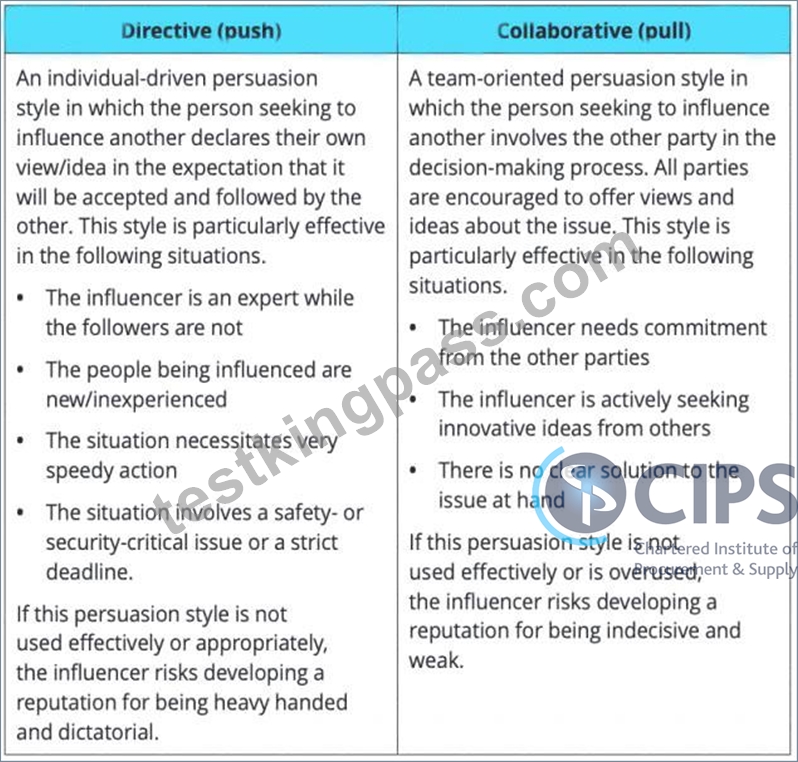
Text Description automatically generated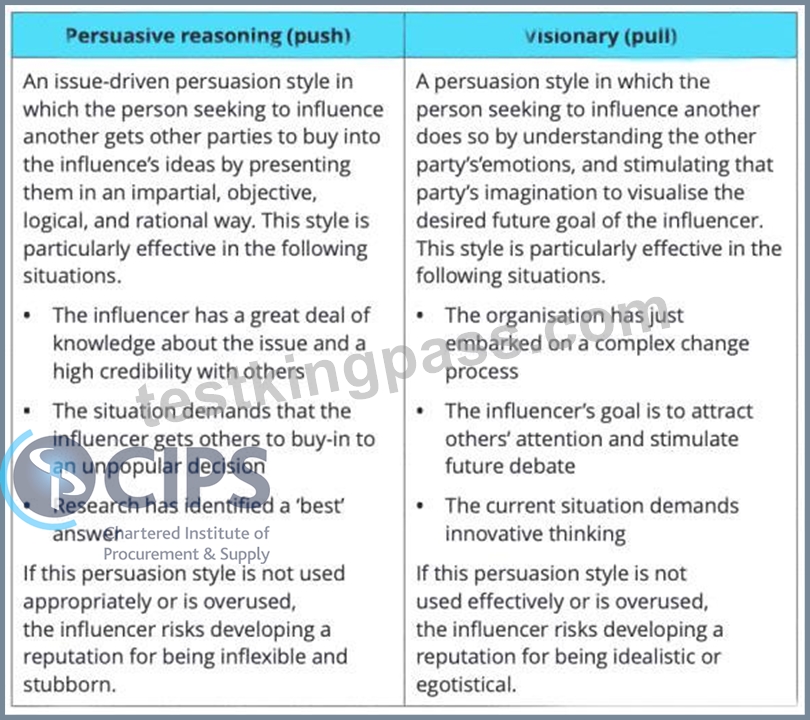
Using logical and objective reasons is one of the typical characteristics of persuasion reasoning method.
NEW QUESTION # 98
Telephone is most likely to be used for which of the following negotiations?
- A. Routinetransactions
- B. Contract for purchasing a specialised product
- C. Complex one-off purchase
- D. High value contract
Answer: A
Explanation:
Explanation
Many commercial negotiations could be considered routine or just not worth the investment for buyers, and using the phone can make more sense and can be more immediate.
LO 2, AC 2.4
NEW QUESTION # 99
When prices of input materials increase, supply curve shifts to the left while demand remains stable. The shift of supply will tend to cause which of the following?
- A. An increase in the equilibrium price and quantity
- B. A decrease in the equilibrium price and an increase in the equilibrium quantity
- C. A decrease in the equilibrium price and quantity
- D. An increase in the equilibrium price and a decrease inthe equilibrium quantity
Answer: D
Explanation:
The case in the question is illustrated as below:
Diagram Description automatically generated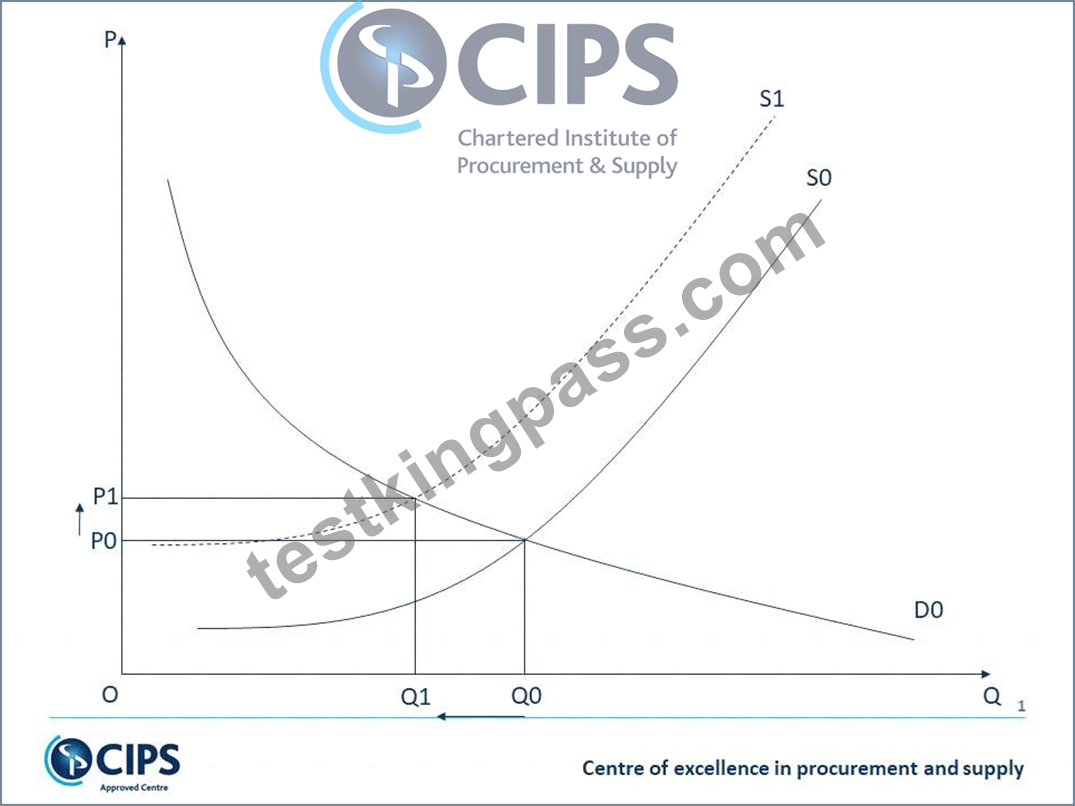
The equilibrium price initially at P0 with quantity Q0, when supply curve shifts to the left, it will converge with demand curve at new equilibrium pointwith price P1 and quantity Q1. As you can see from the graph, P1 is greater than P0 and Q1 is smaller than Q0.
NEW QUESTION # 100
A procurement manager is preparing fora negotiation with an important supplier. He plans to withhold some crucial information so that his company gains the upper hand in the negotiation. Is this correct when considering using integrative approach to the negotiation?
- A. No, this approach requires honest and open discussion
- B. Yes, the buying organisation must maximise its gain, even at the detriment of the other party
- C. Yes, the supplier must know what buyer wants and how to provide that even when the buyer is silent on these matters
- D. No,holding back information will prompt the supplier gain higher negotiation power
Answer: A
Explanation:
Integrative negotiation is a negotiation strategy in which the involved parties work together to find a solution that satisfies the needs and concernsof each. This process often involves group brainstorming and creative thinking for individuals to suggest different ideas that benefit both parties.
Compromising is often common in integrative negotiation, and both sides may need to give up certain needs to reach a solution. Honesty can also promote successful integrative negotiation because it can lead to a comprehensive understanding of the issue and what each party needs to be satisfied with the result.
NEW QUESTION # 101
Which of the following is the internal factor that is taken intoprice of a product?
- A. Risk management
- B. Exchange rate
- C. Elasticity
- D. Customer tastes
Answer: A
Explanation:
Explanation
In order to answer this question, you should better consider each option:
'Exchange rate' is the value of one nation's currency versus thecurrency of another nation or economic zone.
This is a macroeconomic factor.
'Elasticity' refers to the degree to which individuals, consumers or producers change their demand or the amount supplied in response to price or income changes. This is a microeconomic factor Consumer tastes refer to the products and services that consumers consciously choose over others. Consumer tastes are so powerful that they can change how businesses conduct their activity. Like elasticity, this is also a microeconomic factor.
Among 4 options, only risk management is the internal factor. Risk pricing is a strategy applied by many companies in the world. To learn how to price the risk, you can read an article from McKinsey:
https://www.mckinsey.com/business-functions/marketing-and-sales/our-insights/how-to-price-risk-to-win-and-pr This is a question that a student met in her actual exam. The knowledge section is unknown.
LO: Unknown, AC: Unknown
NEW QUESTION # 102
Which of the following is the most appropriate pricing arrangement in contracts where major inputs are commodities?
- A. Fixed pricing arrangement
- B. Cost reimbursable pricingarrangement
- C. Price adjustment mechanism
- D. Standard schedule of rates
Answer: C
Explanation:
In contracts which have major commodity input, the price is determined by market forces with no individual supplier or buyer able to influence it significantly.Prices are much more variable even within long term contracts and seeking a fixed price would create financial risks for both the buyers and the suppliers. It is often intelligent to agree a contract price adjustment mechanism to allow for market price changes so both sides share risk.
NEW QUESTION # 103
What letter R in the acronym SMART stands for?
- A. Relevant
- B. Random
- C. Risk-free
- D. Recommended
Answer: A
Explanation:
Explanation
SMART is an acronym that you can use toguide your goal setting. SMART is an acronym that stands for Specific, Measurable, Achievable, Relevant, and Time-bound A student met this question in the L4M5 exam. SMART is mentioned primarily in L4M3 Commercial Contracting.
LO: Unknown, AC: Unknown
NEW QUESTION # 104
Which of the following are most likely to be fundamentals of Fisher & Ury's principled negotiation?
1. Depersonalise the argument
2. Focuson positions
3. Generate creative options
4. Using subjective criteria
- A. 2 and 4 only
- B. 1 and 4 only
- C. 1 and 3 only
- D. 2 and 3 only
Answer: C
Explanation:
Explanation
Principled negotiation is based on four fundamentals: people, interest, options andcriteria: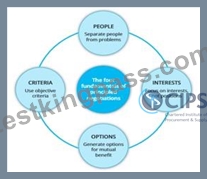
Diagram Description automatically generated
1st Principle: separate the people from the problem: Negotiator should depersonalise the situation and accepting that the subject matter of the negotiation. This can be difficult for untrained negotiators, but this is a key skill to develop
2ndprinciple: focus on interests, not positions: It is important in principled negotiations not to focus on their parties' positions (what are expressed during negotiations), but on the interests (underlying needs) behind them
3rd principle: invent options for mutual gains: this principle aims to help the parties find a solution that both would benefit from. The more options - or tradeables - that can be brought to the table the better.
4th principle: insist on using objective criteria: is about making sure that the negotiation stays focused on outcomes based on objective criteria and that it is productive.
LO 1, AC 1.2
NEW QUESTION # 105
Understanding supplier's mark-up and margin can provide procurement professional a comprehensive insight into supplier's net profits. Is this statement true?
- A. Yes, becausesupplier's mark-up and margin are two most valuable sources of information to procurement
- B. Yes,because these are two indicators of supplier's future prospect
- C. No, because mark-up and margin inform little about supplier's net profit
- D. No, because margin is enough to tell procurement about supplier's profitability
Answer: C
Explanation:
Explanation
Mark-up and margin allow supplier to make gross profit. Remember that every supplier operates under different cost structures and some are set up to be most profitableat a particular level of volume, so it is dangerous to assume all suppliers can survive on a lower margin if their volume increases. Intelligent buyers understand that mark-up and margin may define gross profits, but they tell you very little about a supplier's net profits.
LO 2, AC 2.1
NEW QUESTION # 106
A procurement professional is sourcing low value items. He conducts market analysis and realise that these items can be provided by many suppliers and switching cost between suppliersis relatively low. He also assume that the relationship between buyer and supplier will be transactional rather than long-term. According to Thomas-Kilmann conflict model instrument, which of the following is the most appropriate style that the procurement professional should adopt when negotiating with these suppliers?
- A. Compromising
- B. Collaborating
- C. Competing
- D. Avoiding
Answer: C
Explanation:
According to Thomas-Kilmann conflict model instrument, there are 5 conflict management styles:
Graphical user interface, text, application, email Description automatically generated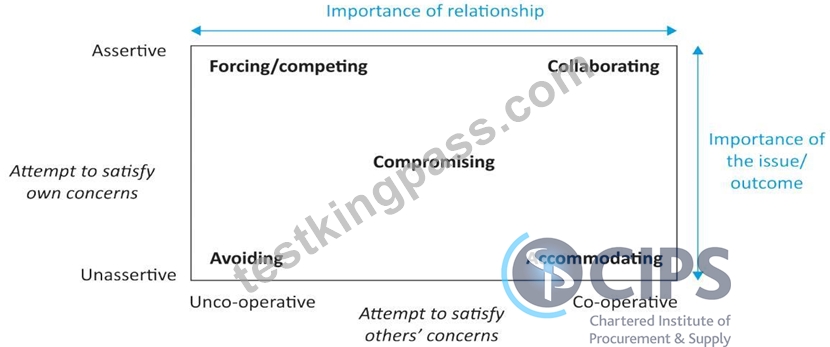
In this scenario, the buyer's bargaining power is stronger than suppliers', and the relationship is transactional.
Therefore, to get the most preferable outcome, the procurement professional can take an assertive approach, while he doesn't need to co-operate closely with these suppliers. Competing will be the most appropriate approach to negotiation in this scenario so that the buying organisation can get a better deal.
NEW QUESTION # 107
......
Dumps MoneyBack Guarantee - L4M5 Dumps Approved Dumps: https://www.testkingpass.com/L4M5-testking-dumps.html
2023 Updated Verified Pass L4M5 Exam - Real Questions and Answers: https://drive.google.com/open?id=1xtWPZEYZQkfssMX2_0sNeM8cQwQmmuOA