


Prepare DP-203 Exam Questions [2023] Recently Updated Questions
Give push to your success with DP-203 exam questions
NEW QUESTION # 36
You are creating dimensions for a data warehouse in an Azure Synapse Analytics dedicated SQL pool.
You create a table by using the Transact-SQL statement shown in the following exhibit.
Use the drop-down menus to select the answer choice that completes each statement based on the information presented in the graphic.
NOTE: Each correct selection is worth one point.
Answer:
Explanation:
Reference:
https://docs.microsoft.com/en-us/learn/modules/populate-slowly-changing-dimensions-azure-synapse-analytics-pipelines/3-choose-between-dimension-types
NEW QUESTION # 37
You need to design the partitions for the product sales transactions. The solution must meet the sales transaction dataset requirements.
What should you include in the solution? To answer, select the appropriate options in the answer area.
NOTE: Each correct selection is worth one point.
Answer:
Explanation:
Reference:
https://docs.microsoft.com/en-us/azure/synapse-analytics/sql-data-warehouse/sql-data-warehouse-overview-what-is
Topic 2, Litware, inc.
Requirements
Business Goals
Litware wants to create a new analytics environment in Azure to meet the following requirements:
See inventory levels across the stores. Data must be updated as close to real time as possible.
Execute ad hoc analytical queries on historical data to identify whether the loyalty club discounts increase sales of the discounted products.
Every four hours, notify store employees about how many prepared food items to produce based on historical demand from the sales data.
Technical Requirements
Litware identifies the following technical requirements:
Minimize the number of different Azure services needed to achieve the business goals.
Use platform as a service (PaaS) offerings whenever possible and avoid having to provision virtual machines that must be managed by Litware.
Ensure that the analytical data store is accessible only to the company's on-premises network and Azure services.
Use Azure Active Directory (Azure AD) authentication whenever possible.
Use the principle of least privilege when designing security.
Stage Inventory data in Azure Data Lake Storage Gen2 before loading the data into the analytical data store. Litware wants to remove transient data from Data Lake Storage once the data is no longer in use. Files that have a modified date that is older than 14 days must be removed.
Limit the business analysts' access to customer contact information, such as phone numbers, because this type of data is not analytically relevant.
Ensure that you can quickly restore a copy of the analytical data store within one hour in the event of corruption or accidental deletion.
Planned Environment
Litware plans to implement the following environment:
The application development team will create an Azure event hub to receive real-time sales data, including store number, date, time, product ID, customer loyalty number, price, and discount amount, from the point of sale (POS) system and output the data to data storage in Azure.
Customer data, including name, contact information, and loyalty number, comes from Salesforce, a SaaS application, and can be imported into Azure once every eight hours. Row modified dates are not trusted in the source table.
Product data, including product ID, name, and category, comes from Salesforce and can be imported into Azure once every eight hours. Row modified dates are not trusted in the source table.
Daily inventory data comes from a Microsoft SQL server located on a private network.
Litware currently has 5 TB of historical sales data and 100 GB of customer data. The company expects approximately 100 GB of new data per month for the next year.
Litware will build a custom application named FoodPrep to provide store employees with the calculation results of how many prepared food items to produce every four hours.
Litware does not plan to implement Azure ExpressRoute or a VPN between the on-premises network and Azure.
NEW QUESTION # 38
You have an Azure Synapse Analytics dedicated SQL pool named Pool1 and an Azure Data Lake Storage Gen2 account named Account 1.
You plan to access the files in Accoun1l by using an external table.
You need to create a data source in Pool1 that you can reference when you create the external table.
How should you complete the Transact-SQL statement? To answer, select the appropriate options in the answer area.
NOTE Each coned selection is worth one point.
Answer:
Explanation:
NEW QUESTION # 39
You use Azure Data Lake Storage Gen2 to store data that data scientists and data engineers will query by using Azure Databricks interactive notebooks. Users will have access only to the Data Lake Storage folders that relate to the projects on which they work.
You need to recommend which authentication methods to use for Databricks and Data Lake Storage to provide the users with the appropriate access. The solution must minimize administrative effort and development effort.
Which authentication method should you recommend for each Azure service? To answer, select the appropriate options in the answer area.
NOTE: Each correct selection is worth one point.
Answer:
Explanation:
Reference:
https://docs.microsoft.com/en-us/azure/databricks/data/data-sources/azure/adls-gen2/azure-datalake-gen2-sas-access
https://docs.microsoft.com/en-us/azure/databricks/security/credential-passthrough/adls-passthrough
NEW QUESTION # 40
You have an Azure Blob storage account that contains a folder. The folder contains 120,000 files. Each file contains 62 columns.
Each day, 1,500 new files are added to the folder.
You plan to incrementally load five data columns from each new file into an Azure Synapse Analytics workspace.
You need to minimize how long it takes to perform the incremental loads.
What should you use to store the files and format?
Answer:
Explanation:
Explanation
Box 1 = timeslice partitioning in the foldersThis means that you should organize your files into folders based on a time attribute, such as year, month, day, or hour. For example, you can have a folder structure like
/yyyy/mm/dd/file.csv. This way, you can easily identify and load only the new files that are added each day by using a time filter in your Azure Synapse pipeline . Timeslice partitioning can also improve the performance of data loading and querying by reducing the number of files that need to be scanned Box = 2 Apache Parquet This is because Parquet is a columnar file format that can efficiently store and compress data with many columns. Parquet files can also be partitioned by a time attribute, which can improve the performance of incremental loading and querying by reducing the number of files that need to be scanned1
23. Parquet files are supported by both dedicated SQL pool and serverless SQL pool in Azure Synapse Analytics2.
NEW QUESTION # 41
You have an Azure SQL database named Database1 and two Azure event hubs named HubA and HubB. The data consumed from each source is shown in the following table.
You need to implement Azure Stream Analytics to calculate the average fare per mile by driver.
How should you configure the Stream Analytics input for each source? To answer, select the appropriate options in the answer area.
NOTE: Each correct selection is worth one point.
Answer:
Explanation:
Explanation
HubA: Stream
HubB: Stream
Database1: Reference
Reference data (also known as a lookup table) is a finite data set that is static or slowly changing in nature, used to perform a lookup or to augment your data streams. For example, in an IoT scenario, you could store metadata about sensors (which don't change often) in reference data and join it with real time IoT data streams. Azure Stream Analytics loads reference data in memory to achieve low latency stream processing Reference:
https://docs.microsoft.com/en-us/azure/stream-analytics/stream-analytics-use-reference-data
NEW QUESTION # 42
You need to output files from Azure Data Factory.
Which file format should you use for each type of output? To answer, select the appropriate options in the answer area.
NOTE: Each correct selection is worth one point.
Answer:
Explanation:
Reference:
https://www.datanami.com/2018/05/16/big-data-file-formats-demystified
NEW QUESTION # 43
You have an Azure Data Factory pipeline that has the activities shown in the following exhibit.
Use the drop-down menus to select the answer choice that completes each statement based on the information presented in the graphic.
NOTE: Each correct selection is worth one point.
Answer:
Explanation:
Reference:
https://datasavvy.me/2021/02/18/azure-data-factory-activity-failures-and-pipeline-outcomes/
NEW QUESTION # 44
You need to collect application metrics, streaming query events, and application log messages for an Azure Databrick cluster.
Which type of library and workspace should you implement? To answer, select the appropriate options in the answer area.
NOTE: Each correct selection is worth one point.
Answer:
Explanation:
References:
https://docs.microsoft.com/en-us/azure/architecture/databricks-monitoring/application-logs
NEW QUESTION # 45
A company plans to use Platform-as-a-Service (PaaS) to create the new data pipeline process. The process must meet the following requirements:
Ingest:
Access multiple data sources.
Provide the ability to orchestrate workflow.
Provide the capability to run SQL Server Integration Services packages.
Store:
Optimize storage for big data workloads.
Provide encryption of data at rest.
Operate with no size limits.
Prepare and Train:
Provide a fully-managed and interactive workspace for exploration and visualization.
Provide the ability to program in R, SQL, Python, Scala, and Java.
Provide seamless user authentication with Azure Active Directory.
Model & Serve:
Implement native columnar storage.
Support for the SQL language
Provide support for structured streaming.
You need to build the data integration pipeline.
Which technologies should you use? To answer, select the appropriate options in the answer area.
NOTE: Each correct selection is worth one point.
Answer:
Explanation:
NEW QUESTION # 46
You are designing an Azure Synapse Analytics dedicated SQL pool.
You need to ensure that you can audit access to Personally Identifiable information (PII).
What should you include in the solution?
- A. column-level security
- B. dynamic data masking
- C. sensitivity classifications
- D. row-level security (RLS)
Answer: C
Explanation:
Data Discovery & Classification is built into Azure SQL Database, Azure SQL Managed Instance, and Azure Synapse Analytics. It provides basic capabilities for discovering, classifying, labeling, and reporting the sensitive data in your databases.
Your most sensitive data might include business, financial, healthcare, or personal information. Discovering and classifying this data can play a pivotal role in your organization's information-protection approach. It can serve as infrastructure for:
Helping to meet standards for data privacy and requirements for regulatory compliance.
Various security scenarios, such as monitoring (auditing) access to sensitive data.
Controlling access to and hardening the security of databases that contain highly sensitive data.
Reference:
https://docs.microsoft.com/en-us/azure/azure-sql/database/data-discovery-and-classification-overview
NEW QUESTION # 47
You have the following Azure Data Factory pipelines
* ingest Data from System 1
* Ingest Data from System2
* Populate Dimensions
* Populate facts
ingest Data from System1 and Ingest Data from System1 have no dependencies. Populate Dimensions must execute after Ingest Data from System1 and Ingest Data from System* Populate Facts must execute after the Populate Dimensions pipeline. All the pipelines must execute every eight hours.
What should you do to schedule the pipelines for execution?
- A. Create a parent pipeline that contains the four pipelines and use a schedule trigger.
- B. Add a schedule trigger to all four pipelines.
- C. Add an event trigger to all four pipelines.
- D. Create a parent pipeline that contains the four pipelines and use an event trigger.
Answer: A
NEW QUESTION # 48
You have a Microsoft SQL Server database that uses a third normal form schema.
You plan to migrate the data in the database to a star schema in an Azure Synapse Analytics dedicated SQI pool.
You need to design the dimension tables. The solution must optimize read operations.
What should you include in the solution? to answer, select the appropriate options in the answer area.
NOTE: Each correct selection is worth one point.
Answer:
Explanation:
Reference:
https://www.mssqltips.com/sqlservertip/5614/explore-the-role-of-normal-forms-in-dimensional-modeling/
https://docs.microsoft.com/en-us/azure/synapse-analytics/sql-data-warehouse/sql-data-warehouse-tables-identity
NEW QUESTION # 49
From a website analytics system, you receive data extracts about user interactions such as downloads, link clicks, form submissions, and video plays.
The data contains the following columns.
You need to design a star schema to support analytical queries of the data. The star schema will contain four tables including a date dimension.
To which table should you add each column? To answer, select the appropriate options in the answer area.
NOTE: Each correct selection is worth one point.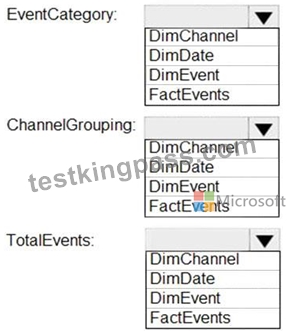
Answer:
Explanation:
Explanation
Table Description automatically generated
Box 1: DimEvent
Box 2: DimChannel
Box 3: FactEvents
Fact tables store observations or events, and can be sales orders, stock balances, exchange rates, temperatures, etc Reference:
https://docs.microsoft.com/en-us/power-bi/guidance/star-schema
NEW QUESTION # 50
Note: This question is part of a series of questions that present the same scenario. Each question in the series contains a unique solution that might meet the stated goals. Some question sets might have more than one correct solution, while others might not have a correct solution.
After you answer a question in this section, you will NOT be able to return to it. As a result, these questions will not appear in the review screen.
You are designing an Azure Stream Analytics solution that will analyze Twitter dat a.
You need to count the tweets in each 10-second window. The solution must ensure that each tweet is counted only once.
Solution: You use a hopping window that uses a hop size of 5 seconds and a window size 10 seconds.
Does this meet the goal?
- A. No
- B. Yes
Answer: A
Explanation:
Instead use a tumbling window. Tumbling windows are a series of fixed-sized, non-overlapping and contiguous time intervals.
Reference:
https://docs.microsoft.com/en-us/stream-analytics-query/tumbling-window-azure-stream-analytics
NEW QUESTION # 51
You have an enterprise data warehouse in Azure Synapse Analytics that contains a table named FactOnlineSales. The table contains data from the start of 2009 to the end of 2012.
You need to improve the performance of queries against FactOnlineSales by using table partitions. The solution must meet the following requirements:
Create four partitions based on the order date.
Ensure that each partition contains all the orders places during a given calendar year.
How should you complete the T-SQL command? To answer, select the appropriate options in the answer area.
NOTE: Each correct selection is worth one point.
Answer:
Explanation:
Reference:
https://docs.microsoft.com/en-us/sql/t-sql/statements/create-partition-function-transact-sql?view=sql-server-ver15
NEW QUESTION # 52
You have an Azure data factory that connects to a Microsoft Purview account. The data factory is registered in Microsoft Purview.
You update a Data Factory pipeline.
You need to ensure that the updated lineage is available in Microsoft Purview.
What should you do first?
- A. Locate the related asset in the Microsoft Purview portal.
- B. Disconnect the Microsoft Purview account from the data factory.
- C. Execute the pipeline.
- D. Execute an Azure DevOps build pipeline.
Answer: C
NEW QUESTION # 53
You are designing a highly available Azure Data Lake Storage solution that will induce geo-zone-redundant storage (GZRS).
You need to monitor for replication delays that can affect the recovery point objective (RPO).
What should you include m the monitoring solution?
- A. Last Sync Time
- B. availability
- C. Average Success Latency
- D. Error errors
Answer: A
Explanation:
Explanation
Because geo-replication is asynchronous, it is possible that data written to the primary region has not yet been written to the secondary region at the time an outage occurs. The Last Sync Time property indicates the last time that data from the primary region was written successfully to the secondary region. All writes made to the primary region before the last sync time are available to be read from the secondary location. Writes made to the primary region after the last sync time property may or may not be available for reads yet.
Reference:
https://docs.microsoft.com/en-us/azure/storage/common/last-sync-time-get
NEW QUESTION # 54
Which Azure Data Factory components should you recommend using together to import the daily inventory data from the SQL server to Azure Data Lake Storage? To answer, select the appropriate options in the answer area.
NOTE: Each correct selection is worth one point.
Answer:
Explanation:
NEW QUESTION # 55
You are building a database in an Azure Synapse Analytics serverless SQL pool.
You have data stored in Parquet files in an Azure Data Lake Storege Gen2 container.
Records are structured as shown in the following sample.
{
"id": 123,
"address_housenumber": "19c",
"address_line": "Memory Lane",
"applicant1_name": "Jane",
"applicant2_name": "Dev"
}
The records contain two applicants at most.
You need to build a table that includes only the address fields.
How should you complete the Transact-SQL statement? To answer, select the appropriate options in the answer area.
NOTE: Each correct selection is worth one point.
Answer:
Explanation:
Reference:
https://docs.microsoft.com/en-us/azure/synapse-analytics/sql/develop-tables-external-tables
NEW QUESTION # 56
You have an Azure Stream Analytics job that is a Stream Analytics project solution in Microsoft Visual Studio. The job accepts data generated by IoT devices in the JSON format.
You need to modify the job to accept data generated by the IoT devices in the Protobuf format.
Which three actions should you perform from Visual Studio on sequence? To answer, move the appropriate actions from the list of actions to the answer area and arrange them in the correct order.
Answer:
Explanation:
Explanation
Step 1: Add an Azure Stream Analytics Custom Deserializer Project (.NET) project to the solution.
Create a custom deserializer
1. Open Visual Studio and select File > New > Project. Search for Stream Analytics and select Azure Stream Analytics Custom Deserializer Project (.NET). Give the project a name, like Protobuf Deserializer.
2. In Solution Explorer, right-click your Protobuf Deserializer project and select Manage NuGet Packages from the menu. Then install the Microsoft.Azure.StreamAnalytics and Google.Protobuf NuGet packages.
3. Add the MessageBodyProto class and the MessageBodyDeserializer class to your project.
4. Build the Protobuf Deserializer project.
Step 2: Add .NET deserializer code for Protobuf to the custom deserializer project Azure Stream Analytics has built-in support for three data formats: JSON, CSV, and Avro. With custom .NET deserializers, you can read data from other formats such as Protocol Buffer, Bond and other user defined formats for both cloud and edge jobs.
Step 3: Add an Azure Stream Analytics Application project to the solution Add an Azure Stream Analytics project
* In Solution Explorer, right-click the Protobuf Deserializer solution and select Add > New Project. Under Azure Stream Analytics > Stream Analytics, choose Azure Stream Analytics Application. Name it ProtobufCloudDeserializer and select OK.
* Right-click References under the ProtobufCloudDeserializer Azure Stream Analytics project. Under Projects, add Protobuf Deserializer. It should be automatically populated for you.
Reference:
https://docs.microsoft.com/en-us/azure/stream-analytics/custom-deserializer
NEW QUESTION # 57
Which Azure Data Factory components should you recommend using together to import the daily inventory data from the SQL server to Azure Data Lake Storage? To answer, select the appropriate options in the answer area.
NOTE: Each correct selection is worth one point.
Answer:
Explanation:
NEW QUESTION # 58
You are creating an Azure Data Factory data flow that will ingest data from a CSV file, cast columns to specified types of data, and insert the data into a table in an Azure Synapse Analytic dedicated SQL pool. The CSV file contains three columns named username, comment, and date.
The data flow already contains the following:
* A source transformation.
* A Derived Column transformation to set the appropriate types of data.
* A sink transformation to land the data in the pool.
You need to ensure that the data flow meets the following requirements:
* All valid rows must be written to the destination table.
* Truncation errors in the comment column must be avoided proactively.
* Any rows containing comment values that will cause truncation errors upon insert must be written to a file in blob storage.
Which two actions should you perform? Each correct answer presents part of the solution.
NOTE: Each correct selection is worth one point.
- A. To the data flow, add a sink transformation to write the rows to a file in blob storage.
- B. To the data flow, add a Conditional Split transformation to separate the rows that will cause truncation errors.
- C. To the data flow, add a filter transformation to filter out rows that will cause truncation errors.
- D. Add a select transformation to select only the rows that will cause truncation errors.
Answer: A,B
Explanation:
Explanation
B: Example:
1. This conditional split transformation defines the maximum length of "title" to be five. Any row that is less than or equal to five will go into the GoodRows stream. Any row that is larger than five will go into the BadRows stream.
2. This conditional split transformation defines the maximum length of "title" to be five. Any row that is less than or equal to five will go into the GoodRows stream. Any row that is larger than five will go into the BadRows stream.
A:
3. Now we need to log the rows that failed. Add a sink transformation to the BadRows stream for logging.
Here, we'll "auto-map" all of the fields so that we have logging of the complete transaction record. This is a text-delimited CSV file output to a single file in Blob Storage. We'll call the log file "badrows.csv".
4. The completed data flow is shown below. We are now able to split off error rows to avoid the SQL truncation errors and put those entries into a log file. Meanwhile, successful rows can continue to write to our target database.
Reference:
https://docs.microsoft.com/en-us/azure/data-factory/how-to-data-flow-error-rows
NEW QUESTION # 59
You have an Azure subscription that contains a logical Microsoft SQL server named Server1. Server1 hosts an Azure Synapse Analytics SQL dedicated pool named Pool1.
You need to recommend a Transparent Data Encryption (TDE) solution for Server1. The solution must meet the following requirements:
* Track the usage of encryption keys.
* Maintain the access of client apps to Pool1 in the event of an Azure datacenter outage that affects the availability of the encryption keys.
What should you include in the recommendation? To answer, select the appropriate options in the answer area.
NOTE: Each correct selection is worth one point.
Answer:
Explanation:
Explanation
Box 1: TDE with customer-managed keys
Customer-managed keys are stored in the Azure Key Vault. You can monitor how and when your key vaults are accessed, and by whom. You can do this by enabling logging for Azure Key Vault, which saves information in an Azure storage account that you provide.
Box 2: Create and configure Azure key vaults in two Azure regions
The contents of your key vault are replicated within the region and to a secondary region at least 150 miles away, but within the same geography to maintain high durability of your keys and secrets.
Reference:
https://docs.microsoft.com/en-us/azure/synapse-analytics/security/workspaces-encryption
https://docs.microsoft.com/en-us/azure/key-vault/general/logging
NEW QUESTION # 60
......
Get DP-203 Actual Free Exam Q&As to Prepare Certification: https://www.testkingpass.com/DP-203-testking-dumps.html
DP-203 100% Guarantee Download DP-203 Exam PDF Q&A: https://drive.google.com/open?id=1Ca5ZZgMzh5-vVlQtCD5uH8TyEkE3Leq-