


[Feb-2023] DP-203 Dumps are Available for Instant Access from TestkingPass
Study resources for the Valid DP-203 Braindumps!
Why it's worth investing in a certification like Microsoft DP-203 Exam
If you are interested in passing Microsoft DP-203 Exam and getting Data Engineering on Microsoft Azure Certification, you should know that this certification will offer you the credibility that employers seek. Data Engineering on Microsoft Azure Certification is an award-winning certification that will allow you to prove your proficiency in cloud computing. It is designed for IT professionals who have knowledge about data engineering and cloud infrastructure services. Data Engineering on Microsoft Azure Certification will help you to demonstrate that you have mastered the skills required to deploy, configure and manage data solutions in the cloud. You will also be able to prove that you have a high level of expertise in the area of data warehousing with SQL Server. Data Engineering on Microsoft Azure Certification has been created to provide individuals with a strong set of skills. Microsoft DP-203 Dumps will enable you to acquire the skills you need to work as a data engineer. It can really help you to get ahead in your career by proving your abilities to potential employers. While it is true that there are many other options available when it comes to certifications, this one offers something special because it provides an opportunity for job seekers as well as working professionals to get a competitive advantage over others when it comes to hiring opportunities. Data Engineering on Microsoft Azure Certificate training has been designed by the best industry experts and they have ensured that all students clear the exam successfully with ease.
NEW QUESTION 78
You plan to monitor an Azure data factory by using the Monitor & Manage app.
You need to identify the status and duration of activities that reference a table in a source database.
Which three actions should you perform in sequence? To answer, move the actions from the list of actions to the answer are and arrange them in the correct order.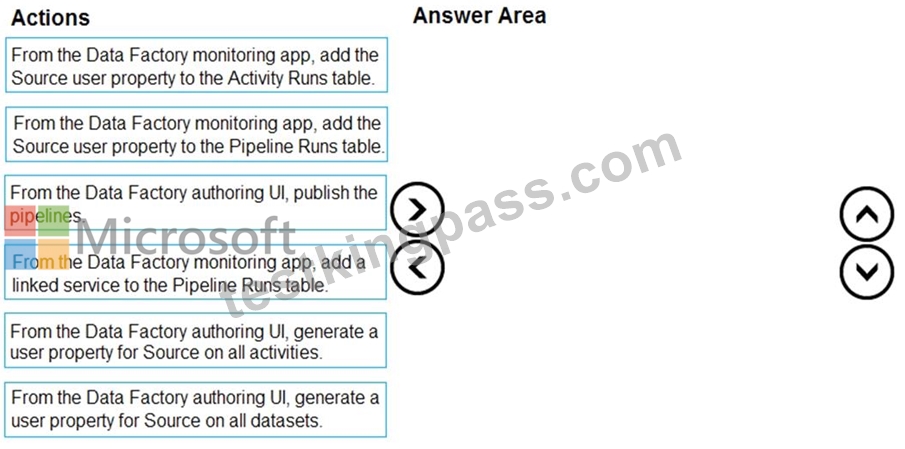
Answer:
Explanation:
1 - From the Data Factory authoring UI, generate a user property for Source on all activities.
2 - From the Data Factory monitoring app, add the Source user property to Activity Runs table.
3 - From the Data Factory authoring UI, publish the pipelines
Reference:
https://docs.microsoft.com/en-us/azure/data-factory/monitor-visually
NEW QUESTION 79
You have a self-hosted integration runtime in Azure Data Factory.
The current status of the integration runtime has the following configurations:
Status: Running
Type: Self-Hosted
Running / Registered Node(s): 1/1
High Availability Enabled: False
Linked Count: 0
Queue Length: 0
Average Queue Duration. 0.00s
The integration runtime has the following node details:
Name: X-M
Status: Running
Available Memory: 7697MB
CPU Utilization: 6%
Network (In/Out): 1.21KBps/0.83KBps
Concurrent Jobs (Running/Limit): 2/14
Role: Dispatcher/Worker
Credential Status: In Sync
Use the drop-down menus to select the answer choice that completes each statement based on the information presented.
NOTE: Each correct selection is worth one point.
Answer:
Explanation:
Reference:
https://docs.microsoft.com/en-us/azure/data-factory/create-self-hosted-integration-runtime
NEW QUESTION 80
You develop data engineering solutions for a company.
A project requires the deployment of data to Azure Data Lake Storage.
You need to implement role-based access control (RBAC) so that project members can manage the Azure Data Lake Storage resources.
Which three actions should you perform? Each correct answer presents part of the solution.
NOTE: Each correct selection is worth one point.
- A. Configure access control lists (ACL) for the Azure Data Lake Storage account.
- B. Assign Azure AD security groups to Azure Data Lake Storage.
- C. Configure service-to-service authentication for the Azure Data Lake Storage account.
- D. Create security groups in Azure Active Directory (Azure AD) and add project members.
- E. Configure end-user authentication for the Azure Data Lake Storage account.
Answer: A,B,D
Explanation:
Reference:
https://docs.microsoft.com/en-us/azure/data-lake-store/data-lake-store-secure-data
NEW QUESTION 81
You are designing database for an Azure Synapse Analytics dedicated SQL pool to support workloads for detecting ecommerce transaction fraud.
Data will be combined from multiple ecommerce sites and can include sensitive financial information such as credit card numbers.
You need to recommend a solution that meets the following requirements:
* Users must be able to identify potentially fraudulent transactions.
* Users must be able to use credit cards as a potential feature in models.
* Users must NOT be able to access the actual credit card numbers.
What should you include in the recommendation?
- A. row-level security (RLS)
- B. column-level encryption
- C. Azure Active Directory (Azure AD) pass-through authentication
- D. Transparent Data Encryption (TDE)
Answer: B
NEW QUESTION 82
You have an Azure Data Lake Storage Gen2 account named adls2 that is protected by a virtual network.
You are designing a SQL pool in Azure Synapse that will use adls2 as a source.
What should you use to authenticate to adls2?
- A. a shared key
- B. a shared access signature (SAS)
- C. an Azure Active Directory (Azure AD) user
- D. a managed identity
Answer: D
Explanation:
Explanation
Managed identity for Azure resources is a feature of Azure Active Directory. The feature provides Azure services with an automatically managed identity in Azure AD. You can use the Managed Identity capability to authenticate to any service that support Azure AD authentication.
Managed Identity authentication is required when your storage account is attached to a VNet.
Reference:
https://docs.microsoft.com/en-us/azure/synapse-analytics/sql-data-warehouse/quickstart-bulk-load-copy-tsql-exa
NEW QUESTION 83
You plan to develop a dataset named Purchases by using Azure databricks Purchases will contain the following columns:
* ProductID
* ItemPrice
* lineTotal
* Quantity
* StorelD
* Minute
* Month
* Hour
* Year
* Day
You need to store the data to support hourly incremental load pipelines that will vary for each StoreID. the solution must minimize storage costs. How should you complete the rode? To answer, select the appropriate options In the answer are a.
NOTE: Each correct selection is worth one point.
Answer:
Explanation:
Reference:
https://intellipaat.com/community/11744/how-to-partition-and-write-dataframe-in-spark-without-deleting-partitions-with-no-new-data
NEW QUESTION 84
You have an Azure Synapse workspace named MyWorkspace that contains an Apache Spark database named mytestdb.
You run the following command in an Azure Synapse Analytics Spark pool in MyWorkspace.
CREATE TABLE mytestdb.myParquetTable(
EmployeeID int,
EmployeeName string,
EmployeeStartDate date)
USING Parquet
You then use Spark to insert a row into mytestdb.myParquetTable. The row contains the following dat a.
One minute later, you execute the following query from a serverless SQL pool in MyWorkspace.
SELECT EmployeeID
FROM mytestdb.dbo.myParquetTable
WHERE name = 'Alice';
What will be returned by the query?
- A. an error
- B. a null value
- C. 0
Answer: C
Explanation:
Once a database has been created by a Spark job, you can create tables in it with Spark that use Parquet as the storage format. Table names will be converted to lower case and need to be queried using the lower case name. These tables will immediately become available for querying by any of the Azure Synapse workspace Spark pools. They can also be used from any of the Spark jobs subject to permissions.
Note: For external tables, since they are synchronized to serverless SQL pool asynchronously, there will be a delay until they appear.
Reference:
https://docs.microsoft.com/en-us/azure/synapse-analytics/metadata/table
NEW QUESTION 85
You are designing a real-time dashboard solution that will visualize streaming data from remote sensors that connect to the internet. The streaming data must be aggregated to show the average value of each 10-second interval. The data will be discarded after being displayed in the dashboard.
The solution will use Azure Stream Analytics and must meet the following requirements:
Minimize latency from an Azure Event hub to the dashboard.
Minimize the required storage.
Minimize development effort.
What should you include in the solution? To answer, select the appropriate options in the answer are a.
NOTE: Each correct selection is worth one point
Answer:
Explanation:
Reference:
https://docs.microsoft.com/en-us/azure/stream-analytics/stream-analytics-power-bi-dashboard
NEW QUESTION 86
You need to design a data storage structure for the product sales transactions. The solution must meet the sales transaction dataset requirements.
What should you include in the solution? To answer, select the appropriate options in the answer area.
NOTE: Each correct selection is worth one point.
Answer:
Explanation:
NEW QUESTION 87
You need to trigger an Azure Data Factory pipeline when a file arrives in an Azure Data Lake Storage Gen2 container.
Which resource provider should you enable?
- A. Microsoft.EventHub
- B. Microsoft.Sql
- C. Microsoft.EventGrid
- D. Microsoft-Automation
Answer: C
NEW QUESTION 88
A company plans to use Platform-as-a-Service (PaaS) to create the new data pipeline process. The process must meet the following requirements:
Ingest:
Access multiple data sources.
Provide the ability to orchestrate workflow.
Provide the capability to run SQL Server Integration Services packages.
Store:
Optimize storage for big data workloads.
Provide encryption of data at rest.
Operate with no size limits.
Prepare and Train:
Provide a fully-managed and interactive workspace for exploration and visualization.
Provide the ability to program in R, SQL, Python, Scala, and Java.
Provide seamless user authentication with Azure Active Directory.
Model & Serve:
Implement native columnar storage.
Support for the SQL language
Provide support for structured streaming.
You need to build the data integration pipeline.
Which technologies should you use? To answer, select the appropriate options in the answer area.
NOTE: Each correct selection is worth one point.
Answer:
Explanation:
NEW QUESTION 89
You are planning a solution to aggregate streaming data that originates in Apache Kafka and is output to Azure Data Lake Storage Gen2. The developers who will implement the stream processing solution use Java, Which service should you recommend using to process the streaming data?
- A. Azure Stream Analytics
- B. Azure Data Factory
- C. Azure Event Hubs
- D. Azure Databricks
Answer: D
Explanation:
https://docs.microsoft.com/en-us/azure/architecture/data-guide/technology-choices/stream-processing
NEW QUESTION 90
You need to implement an Azure Databricks cluster that automatically connects to Azure Data Lake Storage Gen2 by using Azure Active Directory (Azure AD) integration.
How should you configure the new cluster? To answer, select the appropriate options in the answer area.
NOTE: Each correct selection is worth one point.
Answer:
Explanation: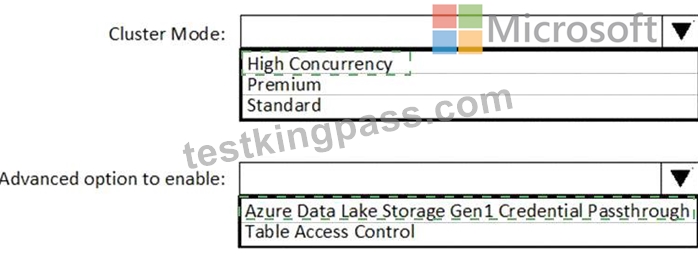
Explanation
Box 1: High Concurrency
Enable Azure Data Lake Storage credential passthrough for a high-concurrency cluster.
Incorrect:
Support for Azure Data Lake Storage credential passthrough on standard clusters is in Public Preview.
Standard clusters with credential passthrough are supported on Databricks Runtime 5.5 and above and are limited to a single user.
Box 2: Azure Data Lake Storage Gen1 Credential Passthrough
You can authenticate automatically to Azure Data Lake Storage Gen1 and Azure Data Lake Storage Gen2 from Azure Databricks clusters using the same Azure Active Directory (Azure AD) identity that you use to log into Azure Databricks. When you enable your cluster for Azure Data Lake Storage credential passthrough, commands that you run on that cluster can read and write data in Azure Data Lake Storage without requiring you to configure service principal credentials for access to storage.
References:
https://docs.azuredatabricks.net/spark/latest/data-sources/azure/adls-passthrough.html
NEW QUESTION 91
You manage an enterprise data warehouse in Azure Synapse Analytics.
Users report slow performance when they run commonly used queries. Users do not report performance changes for infrequently used queries.
You need to monitor resource utilization to determine the source of the performance issues.
Which metric should you monitor?
- A. Cache used percentage
- B. Local tempdb percentage
- C. DWU percentage
- D. Data IO percentage
Answer: A
Explanation:
Monitor and troubleshoot slow query performance by determining whether your workload is optimally leveraging the adaptive cache for dedicated SQL pools.
Reference:
https://docs.microsoft.com/en-us/azure/synapse-analytics/sql-data-warehouse/sql-data-warehouse-how-to-monitor-cache
NEW QUESTION 92
You need to create a partitioned table in an Azure Synapse Analytics dedicated SQL pool.
How should you complete the Transact-SQL statement? To answer, drag the appropriate values to the correct targets. Each value may be used once, more than once, or not at all. You may need to drag the split bar between panes or scroll to view content.
NOTE: Each correct selection is worth one point.
Answer:
Explanation: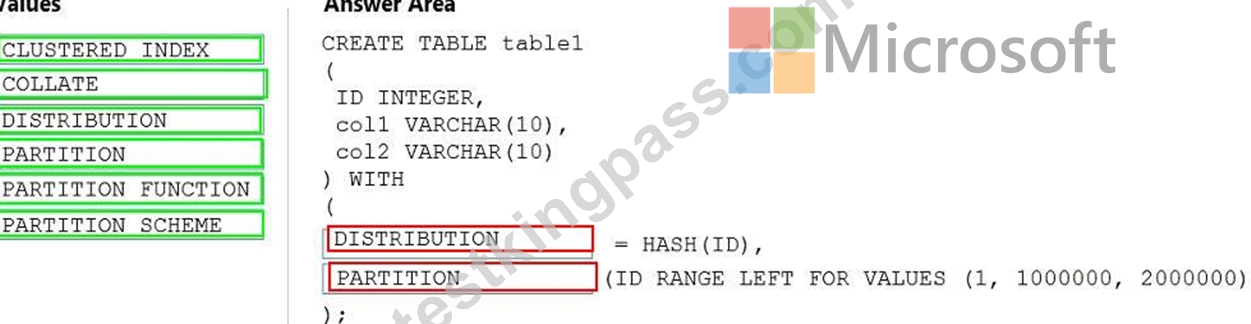
Reference:
https://docs.microsoft.com/en-us/sql/t-sql/statements/create-table-azure-sql-data-warehouse?
NEW QUESTION 93
Which Azure Data Factory components should you recommend using together to import the daily inventory data from the SQL server to Azure Data Lake Storage? To answer, select the appropriate options in the answer area.
NOTE: Each correct selection is worth one point.
Answer:
Explanation:
NEW QUESTION 94
You are designing an enterprise data warehouse in Azure Synapse Analytics that will store website traffic analytics in a star schema.
You plan to have a fact table for website visits. The table will be approximately 5 GB.
You need to recommend which distribution type and index type to use for the table. The solution must provide the fastest query performance.
What should you recommend? To answer, select the appropriate options in the answer area.
NOTE: Each correct selection is worth one point.
Answer:
Explanation:
Reference:
https://docs.microsoft.com/en-us/azure/synapse-analytics/sql-data-warehouse/sql-data-warehouse-tables-distribute
https://docs.microsoft.com/en-us/azure/synapse-analytics/sql-data-warehouse/sql-data-warehouse-tables-index
NEW QUESTION 95
You have an Azure Synapse Analytics dedicated SQL Pool1. Pool1 contains a partitioned fact table named dbo.Sales and a staging table named stg.Sales that has the matching table and partition definitions.
You need to overwrite the content of the first partition in dbo.Sales with the content of the same partition in stg.Sales. The solution must minimize load times.
What should you do?
- A. Switch the first partition from dbo.Sales to stg.Sales.
- B. Switch the first partition from stg.Sales to dbo. Sales.
- C. Insert the data from stg.Sales into dbo.Sales.
- D. Update dbo.Sales from stg.Sales.
Answer: A
NEW QUESTION 96
You have an Azure Synapse Analytics dedicated SQL pool named Pool1. Pool1 contains a table named table1.
You load 5 TB of data intotable1.
You need to ensure that columnstore compression is maximized for table1.
Which statement should you execute?
- A. DBCC INDEXDEFRAG (pool1,tablel)
- B. ALTER INDEX ALL on table1 REBUILD
- C. ALTER INDEX ALL on table1 REORGANIZE
- D. DBCC DBREINOEX (table1)
Answer: B
Explanation:
Columnstore and columnstore archive compression
Columnstore tables and indexes are always stored with columnstore compression. You can further reduce the size of columnstore data by configuring an additional compression called archival compression. To perform archival compression, SQL Server runs the Microsoft XPRESS compression algorithm on the data. Add or remove archival compression by using the following data compression types:
Use COLUMNSTORE_ARCHIVE data compression to compress columnstore data with archival compression.
Use COLUMNSTORE data compression to decompress archival compression. The resulting data continue to be compressed with columnstore compression.
To add archival compression, use ALTER TABLE (Transact-SQL) or ALTER INDEX (Transact-SQL) with the REBUILD option and DATA COMPRESSION = COLUMNSTORE_ARCHIVE.
NEW QUESTION 97
You have an Azure subscription linked to an Azure Active Directory (Azure AD) tenant that contains a service principal named ServicePrincipal1. The subscription contains an Azure Data Lake Storage account named adls1. Adls1 contains a folder named Folder2 that has a URI of
https://adls1.dfs.core.windows.net/container1/Folder1/Folder2/.
ServicePrincipal1 has the access control list (ACL) permissions shown in the following table.
You need to ensure that ServicePrincipal1 can perform the following actions:
* Traverse child items that are created in Folder2.
* Read files that are created in Folder2.
The solution must use the principle of least privilege.
Which two permissions should you grant to ServicePrincipal1 for Folder2? Each correct answer presents part of the solution.
NOTE: Each correct selection is worth one point.
- A. Access - Read
- B. Access - Write
- C. Default - Execute
- D. Access - Execute
- E. Default-Read
- F. Default - Write
Answer: C,E
Explanation:
Explanation
Execute (X) permission is required to traverse the child items of a folder.
There are two kinds of access control lists (ACLs), Access ACLs and Default ACLs.
Access ACLs: These control access to an object. Files and folders both have Access ACLs.
Default ACLs: A "template" of ACLs associated with a folder that determine the Access ACLs for any child items that are created under that folder. Files do not have Default ACLs.
Reference:
https://docs.microsoft.com/en-us/azure/data-lake-store/data-lake-store-access-control
NEW QUESTION 98
......
Familiarize yourself with the format of the Microsoft DP-203 Exam
Microsoft Data Platform (DP) is an exam for IT professionals who are responsible for designing and implementing data processing solutions that integrate with Microsoft platforms, applications, and services. Candidates prepare for this exam by taking the Microsoft Official Curriculum (MOC) course for the Azure Data Engineering on Microsoft Azure certification. The DP-203 exam tests your ability to design and implement data processing solutions on Azure in a cloud environment. You need to understand how to design and create data services with Azure Data Factory; how to create, manage and deploy data models using the Azure Data Catalog; and how to manage the lifecycle of a data solution using Azure Data Lake Analytics. Microsoft DP-203 Dumps Questions and Answers are prepared by experts and reviewed and approved by Microsoft. The test is based on the latest version of Microsoft Data Platform that includes SQL Server 2016, SQL Database, HDInsight, and Power BI. The questions test both technical skills and business knowledge so you need to have a good understanding of both areas in order to pass the test.
Updated DP-203 Tests Engine pdf - All Free Dumps Guaranteed: https://www.testkingpass.com/DP-203-testking-dumps.html
Latest Microsoft Certified: Azure Data Engineer Associate DP-203 Actual Free Exam Questions: https://drive.google.com/open?id=1iDn782JqOV0UySu1qJFPt8NLqNQmUATe