


View All NSK100 Actual Exam Questions Answers and Explanations for Free Oct-2023
The Most In-Demand Netskope NSK100 Pass Guaranteed Quiz
NEW QUESTION # 10
You are working with traffic from applications with pinned certificates. In this scenario, which statement is correct?
- A. Traffic with pinned certificates should be blocked.
- B. The domains used by certificate-pinned applications should be added to the authentication bypass list.
- C. The domains used by applications with pinned certificates should be allowed in an inline policy.
- D. An exception should be added to the steering configuration.
Answer: D
Explanation:
Explanation
When working with traffic from applications with pinned certificates, you should add an exception to the steering configuration to bypass them. Pinned certificates are a security technique that prevents man-in-the-middle attacks by validating the server certificates against a hardcoded list of certificates in the application. If you try to intercept or inspect the traffic from such applications, they will reject the connection or display an error message. Therefore, you should add the domains used by certificate-pinned applications as exceptions in your steering configuration, so that they are not steered to Netskope for analysis and enforcement. References: Certificate Pinned ApplicationsCreating a Steering Configuration
NEW QUESTION # 11
You want to use an out-of-band API connection into your sanctioned Microsoft 365 OneDrive for Business application to find sensitive content, enforce near real-time policy controls, and quarantine malware.
In this scenario, which primary function in the Netskope platform would you use to connect your application to Netskope?
- A. SaaS API-enabled Protection
- B. DLP forensics
- C. Risk Insights
- D. laaS API-enabled Protection
Answer: A
Explanation:
Explanation
SaaS API-enabled Protection is a primary function in the Netskope platform that allows customers to connect their sanctioned SaaS applications to Netskope using out-of-band API connections. This enables customers to find sensitive content, enforce near real-time policycontrols, and quarantine malware in their SaaS applications without affecting user experience or performance. If you want to use an out-of-band API connection into your sanctioned Microsoft 365 OneDrive for Business application to achieve these goals, you should use SaaS API-enabled Protection as the primary function in the Netskope platform. DLP forensics, Risk Insights, and IaaS API-enabled Protection are not primary functions in the Netskope platform that can be used to connect your application to Netskope. References: [Netskope SaaS API-enabled Protection].
NEW QUESTION # 12
A company is attempting to steer traffic to Netskope using GRE tunnels. They notice that after the initial configuration, users cannot access external websites from their browsers.
What are three probable causes for this issue? (Choose three.)
- A. The configured GRE peer in the Netskope platform is incorrect.
- B. The route map was applied to the wrong router interface.
- C. The corporate firewall might be blocking GRE traffic.
- D. Netskope does not support GRE tunnels.
- E. The pre-shared key for the GRE tunnel is incorrect.
Answer: A,B,C
Explanation:
Explanation
In this scenario, there are three probable causes for the issue of users not being able to access external websites from their browsers after attempting to steer traffic to Netskope using GRE tunnels. One cause is that the configured GRE peer in the Netskope platform is incorrect, which means that the Netskope POP that is supposed to receive the GRE traffic from the customer's network is not matching the IP address of the customer's router that is sending the GRE traffic. This will result in a failure to establish a GRE tunnel between the customer and Netskope. Another cause is that the corporate firewall might be blocking GRE traffic, which means that the firewall rules are not allowing the GRE protocol (IP protocol number 47) or the UDP port 4789 (for VXLAN encapsulation) to pass through. This will result in a failure to send or receive GRE packets between the customer and Netskope. A third cause is that the route map was applied to the wrong router interface, which means that the configuration that specifies which traffic should be steered to Netskope using GRE tunnels was not applied to the correct interface on the customer's router. This will result in a failure to steer the desired traffic to Netskope. The pre-shared key for the GRE tunnel is incorrect is not a probable cause for this issue, as GRE tunnelsdo not use pre-shared keys for authentication or encryption.
Netskope does support GRE tunnels, so this is not a cause for this issue either. References: [Netskope Secure Forwarder], Netskope Security Cloud Operation & Administration (NSCO&A) - Classroom Course, Module
3: Steering Configuration, Lesson 3: Secure Forwarder.
NEW QUESTION # 13
What are two characteristics ofNetskope's Private Access Solution? (Choose two.)
- A. It provides protection for private applications.
- B. It acts as a cloud-based firewall.
- C. It requires on-premises hardware.
- D. It provides access to private applications.
Answer: A,D
Explanation:
Explanation
Netskope's Private Access Solution is a service that allows users to securely access private applications without exposing them to the internet or using VPNs. It provides protection for private applications by encrypting the traffic, enforcing granular policies, and preventing data exfiltration. It also provides access to private applications by creating a secure tunnel between the user's device and the application's server, regardless of their location or network. It does not act as a cloud-based firewall, as it does not filter or block traffic based on ports or protocols. Itdoes not require on-premises hardware, as it is a cloud-native solution that leverages Netskope's global network of points of presence (POPs). References: [Netskope Private Access].
NEW QUESTION # 14
Your company asks you to obtain a detailed list of all events from the last 24 hours for a specific user. In this scenario, what are two methods to accomplish this task? (Choose two.)
- A. Export the data from Skope IT Application Events.
- B. Use the Netskope reporting engine.
- C. Use the Netskope REST API.
- D. Export the data from Skope IT Alerts.
Answer: A,C
Explanation:
Explanation
In this scenario, there are two methods to obtain a detailed list of all events from the last 24 hours for a specific user. One method is to export the data from Skope IT Application Events, which is a feature in the Netskope platform that allows you to view and analyze all the activities performed by users on cloud applications. You can use filters to narrow down your search by user name, time range, application, activity, and other criteria. You can then export the data to a CSV or JSON file for further analysis or reporting.
Another method is to use the Netskope REST API, which is a programmatic interface that allows you to access and manipulate data from the Netskope platform using HTTP requests. You can use the API to query for events by user name, time range, application, activity, and other parameters. You can then retrieve the data in JSON format for further analysis or integration with other tools. Using the Netskope reporting engine or exporting the data from Skope IT Alerts are not methods to obtain a detailed list of all events from the last 24 hours for a specific user, as they are more suited for generating summary reports or alerts based on predefined criteria or thresholds, rather than granular event data. References: [Netskope Skope IT Application Events],
[Netskope REST API].
NEW QUESTION # 15
You need to provide a quick view under the Skope IT Applications page showing only risky shadow IT cloud applications being used.
In this scenario, which two filter combinations would you use to accomplish this task? (Choose two.)
- A. Sanctioned = No
- B. CCL = Medium. Low, Poor
- C. User Device Type = Windows Device
- D. CCL = High. Under Research
Answer: A,B
Explanation:
Explanation
To provide a quick view under the Skope IT Applications page showing only risky shadow IT cloud applications being used, you can use two filter combinations: Sanctioned = No and CCL = Medium, Low, Poor. The Sanctioned filter allows you to select whether you want to see only sanctioned or unsanctioned apps in your organization. Sanctioned apps are those that are approved and managed by your IT department, while unsanctioned apps are those that are used without authorization or oversight by your employees. Shadow IT refers to the use ofunsanctioned apps that may pose security or compliance risks for your organization. The CCL filter allows you to select the Cloud Confidence Level (CCL) ratings of the apps you want to see. The CCL rating is a measure of how enterprise-ready a cloud app is based on various criteria such as security, auditability, business continuity, etc. The CCL rating ranges from Excellent to Poor, with Excellent being the most secure and compliant and Poor being the least. Risky cloud apps are those that have a low CCL rating, such as Medium, Low, or Poor. By applying these two filters, you can narrow down the list of apps to only those that are unsanctioned and have a low CCL rating, which indicates that they are risky shadow IT cloud applications being used in your organization. References: SkopeIT ApplicationsNetskope Cloud Confidence Index
NEW QUESTION # 16
You consume application infrastructure (middleware) capabilities by a third-party provider. What is the cloud service model that you are using in this scenario?
- A. SaaS
- B. PaaS
- C. DaaS
- D. MaaS
Answer: B
Explanation:
Explanation
If you consume application infrastructure (middleware) capabilities by a third-party provider, then the cloud service model that you are using in this scenario is PaaS, which stands for Platform as a Service. PaaS is a cloud service model that provides customers with a platform to develop, run, and manage applications without having to deal with the underlying infrastructure or software. PaaS typically includes middleware capabilities such as databases, web servers, development tools, integration services, etc., that customers can use to build and deploy their applications faster and easier. MaaS, DaaS, and SaaS are not cloud service models that match this scenario, as they stand for different types of services. MaaS stands for Monitoring as a Service, which is a service that provides customers with tools to monitor and manage their cloud resources and performance.
DaaS stands for Desktop as a Service, which is a service that provides customers with virtual desktops that they can access from any device or location. SaaS stands for Software as a Service, which is a service that provides customers with software applications that they can use over the internet without installing or maintaining them. References: [PaaS], [MaaS], [DaaS], [SaaS].
NEW QUESTION # 17
What is the limitation of using a legacy proxy compared to Netskope's solution?
- A. Netskope architecture requires on-premises components.
- B. Legacy on-premises solutions fail to provide protection for traffic from on-premises users.
- C. Legacy solutions offer higher performance and scalability for corporate and remote users.
- D. To enforce policies, traffic needs to traverse back through a customer's on-premises security stack.
Answer: D
Explanation:
Explanation
A limitation of using a legacy proxy compared to Netskope's solution is that to enforce policies, traffic needs to traverse back through a customer's on-premises security stack. This creates latency, bandwidth, and scalability issues for remote users and cloud applications. Netskope's solution, on the other hand, leverages a cloud-native architecture that provides high-performance and scalable inspection of traffic from any location and device. References: [Netskope Architecture Overview]
NEW QUESTION # 18
You need to create a service request ticket for a client-related issue using the Netskope client Ul. In this scenario, you generate the client logs by right-clicking on the system tray icon and choosing
- A. Configuration
- B. Save logs
- C. Troubleshoot
- D. Help
Answer: C
Explanation:
Explanation
To create a service request ticket for a client-related issue using the Netskope client UI, you need to generate the client logs by right-clicking on the system tray icon and choosing Troubleshoot. This will open a window where you can select the option to Save Logs, which will create a zip file containing the client logs. You can then attach this file to your service request ticket and provide any relevant details about the issue. Choosing Save logs, Configuration, or Help will not generate the client logs, as they perform different functions, such as saving the current configuration, opening the settings menu, or opening the help page. References: [Netskope Client Troubleshooting].
NEW QUESTION # 19
You want to block access to sites that use self-signed certificates. Which statement is true in this scenario?
- A. Self-signed certificates must be changed to a publicly trusted CA signed certificate.
- B. Certificate-related settings apply globally to the entire customer tenant.
- C. Certificate-related settings apply to each individual steering configuration level.
- D. Certificate-related settings apply to each individual client configuration level.
Answer: C
Explanation:
Explanation
The statement that is true in this scenario is: Certificate-related settings apply to each individual steering configuration level. Certificate-related settings are the options that allow you to configure how Netskope handles SSL/TLS certificates for encrypted web traffic. For example, you can choose whether to allow or block self-signed certificates, expired certificates, revoked certificates, etc. You can also choose whether to enable SSL decryption for specific domains or categories. Certificate-related settings apply to each individual steering configuration level, which means that you can have different settings for different types of traffic or devices. For example, you can have one steering configuration for managed devices and another one for unmanaged devices, and apply different certificate-related settings for each one. This allows you to customize your security policies based on your needs and preferences. References: Netskope SSL DecryptionNetskope Steering Configuration
NEW QUESTION # 20
A customer wants to detect misconfigurations in their AWS cloud instances.
In this scenario, which Netskope feature would you recommend to the customer?
- A. Netskope SaaS Security Posture Management (SSPM)
- B. Netskope Secure Web Gateway (SWG)
- C. Netskope Cloud Security Posture Management (CSPM)
- D. Netskope Advanced DLP and Threat Protection
Answer: C
Explanation:
Explanation
If a customer wants to detect misconfigurations in their AWS cloud instances, the Netskope feature that I would recommend to them is Netskope Cloud Security Posture Management (CSPM). Netskope CSPM is a service that provides continuous assessment and remediation of public cloud deployments for risks, threats, and compliance issues. Netskope CSPM leverages the APIs available from AWS and other cloud service providers to scan the cloud infrastructure for misconfigurations, such as insecure permissions, open ports, unencrypted data, etc. Netskope CSPM also provides security posture policies, profiles, and rules that can be customized to match the customer's security standards and best practices. Netskope CSPM can also alert, report, or remediate the misconfigurations automatically or manually. References: Netskope CSPMCloud Security Posture Management
NEW QUESTION # 21
A customer changes CCI scoring from the default objective score to another score. In this scenario, what would be a valid reason for making this change?
- A. The customer's organization places a higher business risk weight on vendors that claim ownership of their data.
- B. The customer has discovered a new SaaS application that is not yet rated in the CCI database.
- C. The customer's organization uses a SaaS application that is currently listed as "under research".
- D. The customer wants to punish an application vendor for providing poor customer service.
Answer: A
Explanation:
Explanation
The CCI scoring is a way to measure the security posture of cloud applications based on a set of criteria and weights. The default objective score is calculated by Netskope using industry best practices and standards.
However, customers can change the CCI scoring to suit their own business needs and risk appetite. For example, a customer may want to place a higher business risk weight on vendors that claim ownership of their data, as this may affect their data sovereignty and privacy rights. Changing the CCI scoring for this reason would be valid, as it reflects the customer's own security requirements and preferences. Changing the CCI scoring for other reasons, such as discovering a new SaaS application, punishing an application vendor, or using an application under research, would not be valid, as they do not align with the purpose and methodology of the CCI scoring. References: Netskope Security Cloud Operation & Administration (NSCO&A) - Classroom Course, Module 7: Cloud Confidence Index (CCI), Lesson 1: CCI Overview and Lesson 2: CCI Scoring.
NEW QUESTION # 22
You are working with a large retail chain and have concerns about their customer data. You want to protect customer credit card data so that it is never exposed in transit or at rest. In this scenario, which regulatory compliance standard should be used to govern this data?
- A. SOC 3
- B. AES-256
- C. PCI-DSS
- D. ISO 27001
Answer: C
Explanation:
Explanation
PCI-DSS stands for Payment Card Industry Data Security Standard, which is a set of security requirements for organizations that handle credit card data. It aims to protect cardholder data from unauthorized access, disclosure, or theft, both in transit and at rest. PCI-DSS covers various aspects of security, such as encryption, authentication, firewall, logging, monitoring, andincident response. If you are working with a large retail chain and have concerns about their customer data, you should use PCI-DSS as the regulatory compliance standard to govern this data. SOC 3, AES-256, and ISO 27001 are not specific to credit card data protection, although they may have some relevance to general security practices. References: [PCI-DSS], [SOC 3], [AES-256],
[ISO 27001].
NEW QUESTION # 23
You just deployed the Netskope client in Web mode and several users mention that their messenger application is no longer working. Although you have a specific real-time policy that allows this application, upon further investigation you discover that it is using proprietary encryption. You need to permit access to all the users and maintain some visibility.
In this scenario, which configuration change would accomplish this task?
- A. Add a policy in the SSL decryption section to bypass the messenger domain(s).
- B. Create a new custom cloud application using the custom connector that can be used in the real-time policy.
- C. Change the real-time policy to block the messenger application.
- D. Edit the steering configuration and add a steering exception for the messenger application.
Answer: A
Explanation:
Explanation
In this scenario, you have deployed the Netskope client in Web mode, which is a feature that allows you to steer your users' web traffic to Netskope for inspection and policy enforcement. However, some users report that their messenger application is no longer working, even though you have a specific real-time policy that allows this application. Upon further investigation, you discover that the messenger application is using proprietary encryption, which means that Netskope cannot decrypt or inspect the traffic from this application.
To resolve this issue, you need to permit access to all the users and maintain some visibility. The configuration change that would accomplish this task is to add a policy in the SSL decryption section to bypass the messenger domain(s). This will allow Netskope to skip the decryption process for the traffic from the messenger application and pass it through without any modification. However, Netskope will still be able to log some basic information about the traffic, such as source, destination, bytes, etc., for visibility purposes.
Changing the real-time policy to block the messenger application, creating a new custom cloud application using the custom connector, or editing the steering configuration and adding a steering exception for the messenger application are not configuration changes that would accomplish this task, as they would either prevent access to the application, require additional steps or resources, or reduce visibility. References: [Netskope Client], Netskope Security Cloud Operation & Administration (NSCO&A) - Classroom Course, Module 4: Decryption Policy.
NEW QUESTION # 24
Your company asks you to obtain a detailed list of all events from the last 24 hours for a specific user. In this scenario, what are two methods to accomplish this task? (Choose two.)
- A. Export the data from Skope IT Application Events.
- B. Use the Netskope reporting engine.
- C. Use the Netskope REST API.
- D. Export the data from Skope IT Alerts.
Answer: A,C
Explanation:
Explanation
In this scenario, there are two methods to obtain a detailed list of all events from the last 24 hours for a specific user. One method is to export the data from Skope IT Application Events, which is a feature in the Netskope platform that allows you to view and analyze all the activities performed by users on cloud applications. You can use filters to narrow down your search by user name, time range, application, activity, and other criteria. You can then export the data to a CSV or JSON file for further analysis or reporting.
Another method is to use the Netskope REST API, which is a programmatic interface that allows you to access and manipulate data from the Netskope platform using HTTP requests. You can use the API to query for events by user name, time range, application, activity, and other parameters. You can then retrieve the data in JSON format for further analysis or integration with other tools. Using the Netskope reporting engine or exporting the data from Skope IT Alerts are not methods to obtain a detailed list of all events from the last 24 hours for a specific user, as they are more suited for generating summary reports or alerts based on predefined criteria or thresholds, rather than granular event data. References: [Netskope Skope IT Application Events],
[Netskope REST API].
NEW QUESTION # 25
Exhibit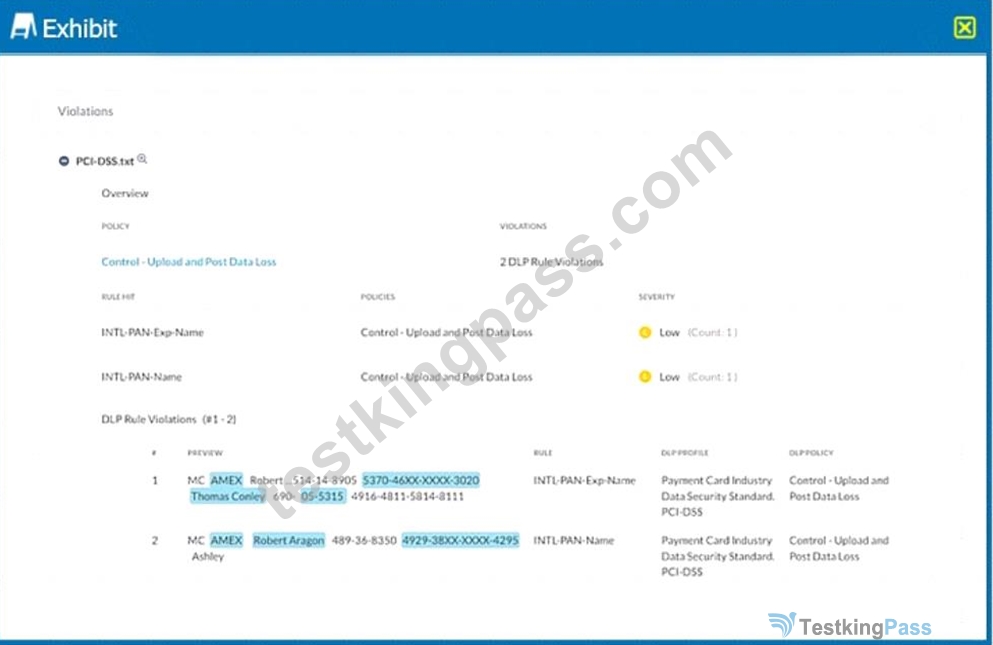
Which portion of the interface shown in the exhibit allows an administrator to set severity, assign ownership, track progress, and perform forensic analysis with excerpts of violating content?
- A. API-enabled Protection -> Inventory
- B. Skope IT-> Alerts
- C. Reports -> New Report
- D. Incidents -> DLP
Answer: D
Explanation:
Explanation
The portion of the interface shown in the exhibit that allows an administrator to set severity, assign ownership, track progress, and perform forensic analysis with excerpts of violating content is Incidents -> DLP. The Incidents dashboard provides a comprehensive view of all the incidents that have occurred in your cloud environment, such as DLP violations, malware infections, anomalous activities, etc. You can filter the incidents by various criteria, such as app name, incident type, severity, user name, etc. You can also drill down into each incident to see more details, such as file name, file path, file owner, file size, file type, etc. You can also assign an owner to an incident, change its status and severity, add notes or comments, and view the excerpts of the violating content that triggered the DLP policy. References: Netskope Incidents Dashboard
NEW QUESTION # 26
You want to take into account some recent adjustments to CCI scoring that were made in your Netskope tenant.
In this scenario, which two CCI aspects in the Ul would be used in a real-time protection policy? (Choose two.)
- A. App Tag
- B. CCL
- C. GDPR Readiness
- D. App Score
Answer: A,D
Explanation:
Explanation
To take into account some recent adjustments to CCI scoring that were made in your Netskope tenant, you can use the App Tag and App Score aspects in the UI to create a real-time protection policy. The App Tag is a label that indicates the level of enterprise readiness of a cloud app based on its CCI score. The App Score is a numerical value that represents the CCI score of a cloud app based on various criteria such as security, auditability, and business continuity. You can use these aspects to filter cloud apps by their CCI ratings and apply policies accordingly. For example, you can create a policy that blocks access to cloud apps with an App Tag of Poor or an App Score below 50. References: Netskope Cloud Confidence IndexCreating Real-Time Policies for Cloud Applications
NEW QUESTION # 27
Why would you want to define an App Instance?
- A. to enable the instance_id attribute in the advanced search field when using query mode
- B. to create an API Data Protection Policy for a personal Box instance
- C. to differentiate between an enterprise Google Drive instance vs. a personal Google Drive instance
- D. to differentiate between an enterprise Google Drive instance vs. an enterprise Box instance
Answer: C
Explanation:
Explanation
An App Instance is a feature in the Netskope platform that allows you to define and identify different instances of the same cloud application based on the domain name or URL. For example, you can define an App Instance for your enterprise Google Drive instance (such as drive.google.com/a/yourcompany.com) and another App Instance for your personal Google Drive instance (such as drive.google.com). This way, you can differentiate between them and apply different policies and actions based on the App Instance. You would want to define an App Instance to achieve this level of granularity and control over your cloud application activities. Creating an API Data Protection Policy for a personal Box instance, enabling the instance_id attribute in the advanced search field, or differentiating between an enterprise Google Drive instance vs. an enterprise Box instance are not valid reasons to define an AppInstance, as they are either unrelated or irrelevant to the App Instance feature. References: Netskope Security Cloud Operation & Administration (NSCO&A) - Classroom Course, Module 5: Real-Time Policies, Lesson 4: App Instances.
NEW QUESTION # 28
You want to prevent Man-in-the-Middle (MITM) attacks on an encrypted website or application. In this scenario, which method would you use?
- A. Use a proxy for the connection.
- B. Use a weaker encryption algorithm.
- C. Use certificate pinning.
- D. Use a stronger encryption algorithm.
Answer: C
Explanation:
Explanation
To prevent Man-in-the-Middle (MITM) attacks on an encrypted website or application, one method that you can use is certificate pinning. Certificate pinning is a technique that restricts which certificates are considered valid for a particular website or application, limiting risk. Instead of allowing any trusted certificate to be used, operators "pin" the certificate authority (CA) issuer(s), public keys or even end-entity certificates of their choice. Certificate pinning helps to prevent MITM attacks by validating the server certificates against a hardcoded list of certificates in the website or application. If an attacker tries to intercept or modify the traffic using a fraudulent or compromised certificate, it will be rejected by the website or application as invalid, even if it is signed by a trusted CA. References: Certificate pinning - IBMCertificate and Public Key Pinning | OWASP Foundation
NEW QUESTION # 29
You investigate a suspected malware incident and confirm that it was a false alarm.
- A. In this scenario, how would you prevent the same file from triggering another incident?
- B. Export the packet capture to a pcap file.
- C. Add the hash to the file filter.
- D. Quarantine the file. Look up the hash at the VirusTotal website.
Answer: C
Explanation:
Explanation
A file filter is a list of file hashes that you can use to exclude files from inspection by Netskope. By adding the hash of the file that triggered a false alarm to the file filter, you can prevent it from being scanned again by Netskope and avoid generating another incident. Quarantining the file, exporting the packet capture, or looking up the hash at VirusTotal are not effective ways to prevent the same file from triggering another incident, as they do not affect how Netskope handles the file. References: Netskope Security Cloud Operation & Administration (NSCO&A) - Classroom Course, Module 6: Data Loss Prevention, Lesson 2: File Filters.
NEW QUESTION # 30
What are two pillars of CASB? (Choose two.)
- A. cloud native
- B. visibility
- C. SASE
- D. compliance
Answer: B,D
Explanation:
Explanation
Two pillars of CASB are visibility and compliance. CASB stands for Cloud Access Security Broker, which is a solution that provides visibility and control over cloud services and web traffic, as well as data and threat protection for cloud users and devices. Visibility is thecapability to identify all cloud services in use and assess their risk factors, such as security, auditability, business continuity, etc. Compliance is the capability to ensure that cloud services and data meet the regulatory standards and policies of the organization or industry, such as GDPR, HIPAA, PCI DSS, etc. References: What Is a Cloud Access Security Broker (CASB)? | MicrosoftCASB Guide: What are the 4 Pillars of CASB? - Security Service Edge
NEW QUESTION # 31
......
NSK100 Free Certification Exam Material with 62 Q&As : https://www.testkingpass.com/NSK100-testking-dumps.html
New Version NSK100 Certificate & Helpful Exam Dumps is Online: https://drive.google.com/open?id=1l2zIDaolJ3mmyfZyMEEJErf0qkyJxoMc