


2024 Latest NS0-593 dumps - Instant Download PDF
Updated Verified NS0-593 Downloadable Printable Exam Dumps
NEW QUESTION # 12
Recently, a CIFS SVM was deployed and is working. The customer wants to use the Dynamic DNS (DDNS) capability available in NetApp ONTAP to easily advertise both data UFs to their clients. Currently. DNS is only responding with one data LIF. DDNS is enabled on the domain controllers.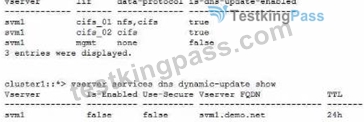
Referring to the exhibit, which two actions should be performed to enable DDNS updates to work? (Choose two.)
- A. Enable the -use-secure parameter for the SVM DDNS services.
- B. Enable the -is-enabled parameter for the SVM DDNS services
- C. Disable the -vserver-fqdn parameter for the SVM DDNS services.
- D. Remove the NFS protocol from the cifs_01 data LIF.
Answer: B,D
Explanation:
To enable DDNS updates to work, two actions should be performed:
Remove the NFS protocol from the cifs_01 data LIF. This is because DDNS updates are only supported for LIFs that have only one data protocol enabled1. The cifs_01 LIF has both NFS and CIFS protocols enabled, which prevents it from registering its DNS record dynamically. By removing the NFS protocol from the cifs_01 LIF, it will become eligible for DDNS updates.
Enable the -is-enabled parameter for the SVM DDNS services. This is because the -is-enabled parameter controls whether the SVM sends DDNS updates to the DNS servers2. The exhibit shows that the -is-enabled parameter is set to false for the svm1 SVM, which means that it does not send any DDNS updates. By enabling the -is-enabled parameter, the SVM will start sending DDNS updates for its eligible LIFs. Reference:
1: Configure dynamic DNS services3
2: Manage DNS/DDNS services with System Manager4
NEW QUESTION # 13
You have connection Issues from a Linux host to an AFF A400 FC LUN. You are asked by support to run the
NetApp sanlun command to provide troubleshooting information.
Which NetApp software package must be installed on the host?
- A. Host Utilities package
- B. SnapDrive for UNIX
- C. Inventory Collect Tool
- D. Virtual Storage Console
Answer: A
NEW QUESTION # 14
A system panic due to an "L2 watchdog timeout hard reset" error occurred. You have found a FIFO message
in the SP log.
Which FIFO message Is useful for Investigating this Issue?
- A. before NMI BBSP:C=00 L=00 FIFO: F3 F2 F1 F0 5 B2 0 0 0 80 20 E F E3 C0 C2 3 4 6 7 9 9 A
- B. before Reset BBSP:C=00 L=00 FIFO:
- C. ONTAP Shutdown BBSP:C=00 L=2F FIFO:
- D. BIOS exit BBSP:C=2F L=20 FIFO: 2 C8 C9 C4 24 4 6 18 7 8 11
Answer: D
NEW QUESTION # 15
You want to assign storage access to an NVMe protocol host.
Which three objects must beconfigured to accomplish this task? (Choose three.)
- A. an NVMe LIF
- B. the NVMe subsystem
- C. an NVMe LUN
- D. the NVMe namespace
- E. the NVMe broadcast domain
Answer: A,B,E
NEW QUESTION # 16
You are trying to deploy a Connector in the AWScloud from NetApp Cloud Manager. The deployment fails
and shows the message 'Insufficient permissions to deploy Cloud Connector". You have verified the AWS
access key and the AWS secret key.
In this scenario, what Is the reason that the deployment failed?
- A. The Connector can be deployed only inAWS GovCloud (US).
- B. The required Identity and Access Management (IAM) policies were not Installed.
- C. The user lacks the permission to deploy within Cloud Manager.
- D. No AWS Marketplace subscription is associated with Cloud Manager.
Answer: C
NEW QUESTION # 17
You are troubleshooting a CIFS connection issue that is reported by some users. You decide to collect a packet
trace.
In this scenario, after you generate the packet trace, where do you find the trace file?
- A. /packet_traces of the node hosting the LIF
- B. /etc/log/packet_traces of the node hosting the LIF
- C. /etc/log/mlog/packet._traces Of all nodes
- D. /vol0/paclcet_traces of the CIFS SVM
Answer: C
NEW QUESTION # 18
A customer reports that some of their client computers are unable to access a FlexGroup over CIFS. This
problem involves only their older Windows XP clients and some printers and scanners.
In this scenario, which statement Is correct?
- A. These systems use the SMQI protocol which Is an unsupported feature in FlexGroup
- B. FlexGroup requires CIFS shares to be located in qtrees, which these clients do not support.
- C. FlexGroup requires CIFS shares to use the Continuously Available Feature, which these clients do not
support. - D. These systems use Offloaded Data Transfer, which is an unsupported feature in FlexGroup.
Answer: C
NEW QUESTION # 19
You created a new NetApp ONTAP FlexGroup volume spanning six nodes and 12 aggregates with a total size
of 4 TB. You added millions of files to the FlexGroup volume with a flat directory structure totaling 2 TB, and
you receive anout of apace error message on your host.
What would cause this error?
- A. All constituent volumes are full.
- B. The maxdirsize Is exceeded in the ONTAP software.
- C. The inode limit is exceeded in the ONTAP software.
- D. The maximum number of volume constituents has been reached in the ONTAP software.
Answer: C
NEW QUESTION # 20
You are troubleshooting a CIFS connection issue that is reported by some users. You decide to collect a packet trace.
In this scenario, after you generate the packet trace, where do you find the trace file?
- A. /packet_traces of the node hosting the LIF
- B. /etc/log/mlog/packet._traces Of all nodes
- C. /etc/log/packet_traces of the node hosting the LIF
- D. /vol0/paclcet_traces of the CIFS SVM
Answer: C
Explanation:
According to the NetApp Knowledge Base, packet traces are stored in the /etc/log/packet_traces directory of the node hosting the LIF. This applies to ONTAP 9.10 and above systems. For ONTAP 9.2 to 9.9 systems, the procedure to capture packet traces is similar, but the command syntax is slightly different. For ONTAP pre-9.2 systems, the procedure is different and requires the use of the tcpdump command. Reference = How to capture packet traces on ONTAP 9.10+ systems, How to capture packet traces (tcpdump) on ONTAP 9.2 to 9.9 systems, How to capture packet traces in ONTAP pre-9.2
NEW QUESTION # 21
After expanding a two-node AFF A300 cluster with two AFF A700 nodes, you observe latencies when data is
accessed indirectly. The system node run -node -command netstat command shows retransmits and packet
drops on the LIFs. The AFF A700 nodes with 40 Gbps and the AFF A300 connect with 10 Gbps to the cluster
interconnect. You are using Cisco Nexus 3132Q cluster interconnect switches. You just updated to ONTAP
9.8 software.
In this scenario, what is causing this problem?
- A. AFF A300 and AFF A700 node mixing Isnot supported in ONTAP 9.8 software.
- B. The AFF A300 Is using an adapter card for the cluster Interconnect, but only onboard ports are supported.
- C. The 10 Gbps to 10 Gbps cluster Interconnect is creating a speed mismatch.
- D. There is an NXOS firmware mismatch, verify in the Interoperability Matrix (1MTJ for a supportedversion.
Answer: C
NEW QUESTION # 22
A customer is calling you to troubleshoot why users are unable to connect to their CIFS SVM.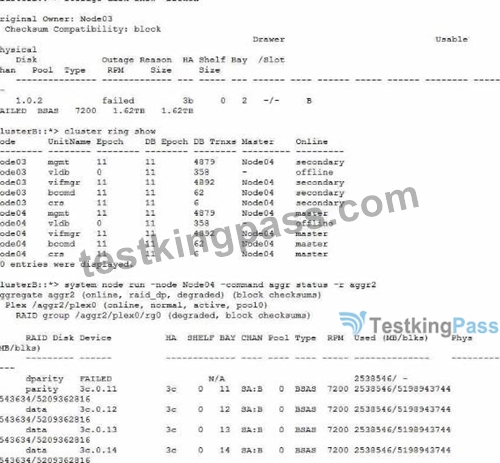
Referring to the Information shown in the exhibit, what Is the source of the problem?
- A. The v1db database is offline.
- B. The broken disk in Node03 is the source of the problem.
- C. The aggregate aggr2 has a failed disk.
- D. The databases On Node03 must be Switched from secondary to master.
Answer: B
Explanation:
The broken disk in Node03 is causing the cluster ring to be offline, which prevents the CIFS SVM from being accessible. The cluster ring is a distributed database that stores cluster configuration information and enables communication between cluster nodes. If the cluster ring is offline, the cluster cannot function properly and the CIFS SVM cannot serve data to clients. The other options are not relevant to the CIFS SVM connectivity issue. Reference = https://www.netapp.com/support-and-training/netapp-learning-services/certifications/support-engineer/
https://mysupport.netapp.com/site/docs-and-kb
NEW QUESTION # 23
Your customer has deployed a two petabyte NetAppONTAP FlexGroup volume across their 4-node ONIAP
9.8 cluster. They plan to store over three billion files. They want to prevent file 10 conflicts since files are
placed into the FlexGroup volume.
In this scenario, which two NFS SVM parameters should be enabled? (Choose two.)
- A. -v3-fsid-change
- B. -v4-fsid-change
- C. -v4-64bit-idantifiers
- D. -v3-64bit-identifiers
Answer: A,D
NEW QUESTION # 24
You Just used the CLI to create a NetApp ONTAP FlexGroup Volume on a NetApp Cloud Volumes ONTAP
instance. After creation, you notice odd behavior in NetApp Cloud Manager.
In this scenario,what Is the reason for this behavior?
- A. The Capacity Management Mode within Cloud Manager should be set to Automatic.
- B. Cloud Volumes ONTAP does not support FlexGroup volumes.
- C. Cloud Manager must be used to provision the FlexGroup volume.
- D. The Capacity Management Mode within Cloud Manager should be set to Manual.
Answer: C
NEW QUESTION # 25
A customer calls you to troubleshoot a network issue. The customer wants to create a packet trace for allclients
on the 192.168.9.0/24 subnet.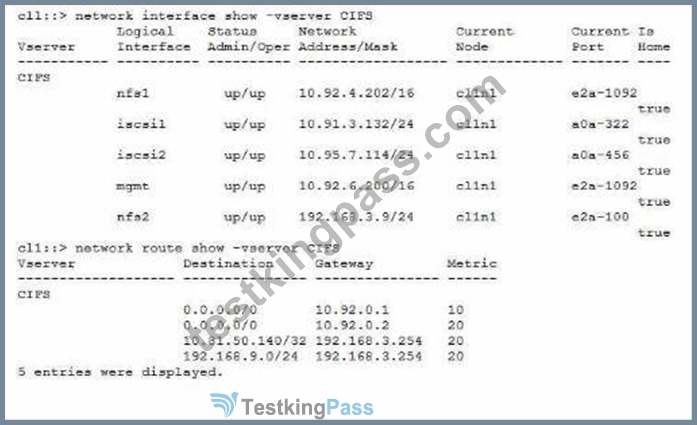
Referring to the exhibit, on which interface do you have to run the packet trace?
- A. a0a-322
- B. e2a-1092
- C. a0a-456
- D. e2a-100
Answer: B
NEW QUESTION # 26
You are optimizing your Cloud Volumes ONTAP. For interoperability and consolidation purposes, you need to know the storage limits.
In this scenario, which source should be reviewed?
- A. NetApp Cloud Volumes ONTAP Release Notes
- B. Cloud Central
- C. Interoperability Matrix Tool (IMT)
- D. Hardware Universe
Answer: A
Explanation:
= The NetApp Cloud Volumes ONTAP Release Notes provide the most up-to-date and accurate information about the storage limits for different cloud platforms, licenses, and configurations. The release notes also include details about supported features, known issues, and limitations for each version of Cloud Volumes ONTAP. Reference = Storage limits - NetApp, Storage limits | NetApp Documentation, Storage limits in AWS | NetApp Documentation, Storage limits in Azure | NetApp Documentation
NEW QUESTION # 27
Your customer complains that u host will constantly report losing a connection to the iSCSl target and then report that the session was reestablished.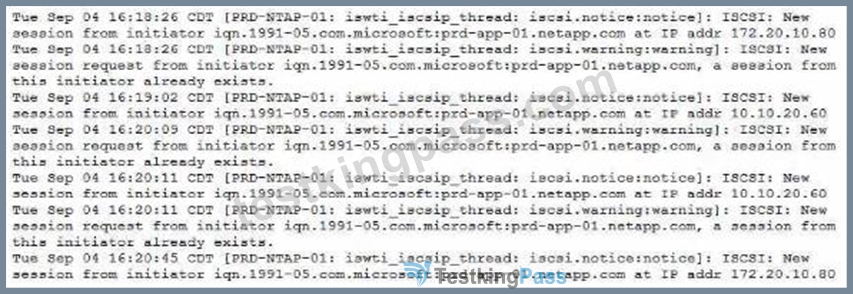
As shown in the exhibit, what is a cause of this flapping?
- A. A host with an IP address of 172.20.10.80 and a second host with an IP address of 10.10.20.60 are in different initiator groups.
- B. A host with an IP address of 172.20.10.80 and a second IP address of 10.10.20.60 is accessing different LUNs.
- C. A host with an IP address of 172.20.10.80 and a second host with an IP address of 10.10.20.60 are accessing the same LUN.
- D. A host with an IP address of 172.20.10.80 and a second host with an IP address of 10.10.20.60 have the same IQN.
Answer: D
Explanation:
IQN stands for iSCSI Qualified Name, which is a unique identifier for an iSCSI initiator or target1.
ONTAP uses IQN to authenticate and authorize iSCSI sessions2.
If two hosts have the same IQN, they will cause a conflict and ONTAP will reject the new session request from the second host3.
This will result in the host losing the connection to the iSCSI target and then reporting that the session was reestablished, as shown in the exhibit.
To avoid this problem, each host should have a unique IQN. Reference:
iSCSI Qualified Name (IQN) - NetApp
iSCSI authentication and authorization - NetApp
Troubleshooting iSCSI issues - NetApp
[Configuring iSCSI initiators - NetApp]
NEW QUESTION # 28
A customer reports that while Installing Windows updates on their external Vscan servers, clients couldnot
access any files on their CIF-S SVM. The problem disappeared after the update process was completed. The
customer wants to prevent this issue from happening during the next patch window.
In this scenario, what are two ways to accomplish this task? (Choose two.)
- A. Modify the CIFS shares to be continuously available (CA) shares.
- B. Enable the -scan-mandatory flag in the Vscan policy.
- C. Update the Vscan servers one at a time.
- D. Disable the -scan-mandatory flag in the Vscan policy.
Answer: A,B
NEW QUESTION # 29
After a motherboard replacement on a NetApp AFF A300 in a SAN environment, the customer states that
ports 0e and 0f are unable toconnect to the fabric. The ports report "offline".
What would you examine first to troubleshoot the issue?
- A. storage port show command output
- B. vserver fcp wwpn-alias show command output
- C. system node hardware unified-connect show command output
- D. vserver fcp interface show command output
Answer: A
NEW QUESTION # 30
A storage administrator reports that a monitoring toot is reporting that the storage controller reads between 90% to 93% CPU use. You run the sysstat -m command against the node in question.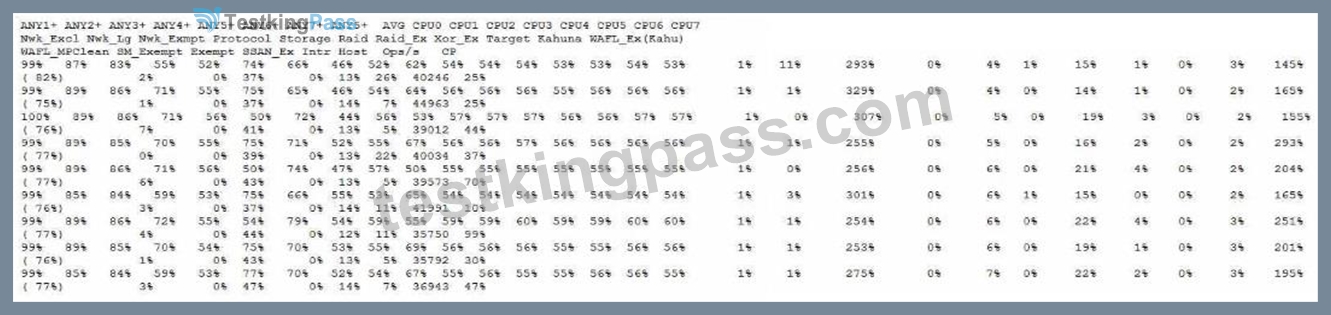
Referring to the exhibit, which statement is correct?
- A. The CPU Is not a first-order monitoring metric for ONTAP.
- B. High network exempt use could be a problem.
- C. The customer should be advised to exclude certain workflows to reduce use.
- D. You should immediately investigate further by gathering perfstat data and opening a support case.
Answer: A
Explanation:
= CPU utilization in ONTAP is not a linear measure of the system load, nor can it be used alone as a measure of the overall system utilization. ONTAP uses a Coarse Symmetric Multiprocessing (CSMP) design which partitions system functions into logical processing domains, each with its own scheduling rules and resource availability. Therefore, a high CPU utilization does not necessarily indicate a performance problem, unless it is accompanied by other contributing factors such as high latency, low throughput, or high queue depth. ONTAP has several mechanisms to optimize CPU usage and balance the workload across the cores, such as WAFL parallelization, exempt processing, and CPU pinning. The CPU utilization reported by the sysstat command is an average across all cores and domains, and does not reflect the actual CPU activity or availability for each domain. Therefore, the CPU is not a first-order monitoring metric for ONTAP, and other metrics such as latency, throughput, and queue depth should be considered first. Reference = What is CPU utilization in Data ONTAP: Scheduling and Monitoring?, How to measure CPU utilization, What are CPU as a compute resource and the CPU domains in ONTAP 9?, Monitoring CPU utilization before ONTAP upgrade
NEW QUESTION # 31
Your customer Informs you about SnapMlrror problems after upgrading NetApp ONTAP software to a newer version. After investigating the event logs and the SnapMirror history, you see information about delayed updates of the SnapMirror relationships.
How would your customer prevent such problems in the future?
- A. Quiesce the SnapMirror relationships before upgrading the ONTAP software.
- B. Delete the SnapMirror relationships and create them new after upgrading the ONTAP software.
- C. Verify that the cabling of the hardware port that Is responsible for SnapMirror transfers Is correct.
- D. Modify the schedules of the SnapMirror relationships after upgrading the ONTAP software.
Answer: A
Explanation:
Quiescing the SnapMirror relationships before upgrading the ONTAP software ensures that the data replication is completed and consistent across the source and destination volumes. This prevents any data loss or corruption due to the upgrade process. Quiescing also suspends the scheduled updates until the relationships are resumed, avoiding any delays or failures in the transfers. The other options are not effective in preventing the SnapMirror problems after the upgrade. Reference = https://docs.netapp.com/us-en/ontap/upgrade/concept_upgrade_requirements_for_snapmirror.html
https://docs.netapp.com/us-en/ontap-systems-upgrade/upgrade-arl-auto-app/resume_snapmirror_operations.html
NEW QUESTION # 32
A customer enabled NFSv4.0on an SVM and changed the client mount from NFSv3 to NFSv4. Afterwards,
the customer found that the directory owner was changed from root to nobody.
In this scenario, which statement is true?
- A. The clients must be restarted to start using NFSv4.
- B. The customer did not configure name services on the SVM.
- C. The export policy is not configured properly.
- D. The ID mapping domains do not match between the client and server.
Answer: C
NEW QUESTION # 33
A customer's storage administrator Informs you about the deactivated Automatic Switchover (AUSO) feature
on their MetroCluster IP environment.
What Information would you tell your customer in this scenario?
- A. The AUSO feature is not available in Metrocluster IP installations by design.
- B. This is a configuration failure, you can activate that feature for the customer.
- C. A faulty link automatically deactivated the AUSO feature.
- D. The AUSO feature cannot be activated due to a non-mirrored aggregate.
Answer: D
NEW QUESTION # 34
You receive the "Unable to connect to the management gateway server"error when trying to connect to a node
management IP.
In this situation, how do you determine whether core dumps are generated for the mgwd user space process?
- A. Log in to the systemshell and collect core dumps from thesystemshell.
- B. Log in to the service processor and collect the core dumps from the service processor.
- C. Log in to the nodeshell using the node console and collect the core dumps from the nodeshell.
- D. Log in to the clustershell using the node console and collect the core dumps from the clustershell.
Answer: B
NEW QUESTION # 35
You ate connecting a Windows Server 2019 hostto ISCSI LUNs on a 4-node AFF A250 cluster running
NetApp ONIAP 9.8 software. The host is unable to connect to the target interface, and the ONTAP event log
has the message shown below.
ISCSI: network interface identifier disabled for use; incoming connection discarded
In this scenario, what is the cause of this connection issue?
- A. The iSCSI service is not enabled on the interface.
- B. iSNS is not enabled on the storage virtual machine.
- C. The WWPN was not added to the initiator group.
- D. CHAP isnot configured correctly for the specified initiator.
Answer: C
NEW QUESTION # 36
......
The Ultimate Network Appliance NS0-593 Dumps PDF Review: https://www.testkingpass.com/NS0-593-testking-dumps.html
Achieve The Utmost Performance In NS0-593 Exam Pass Guaranteed: https://drive.google.com/open?id=1EVBIRNuxMFg-Tty_wafBFUbzxmw066lg