


2026 Updated Verified Pass ClaimCenter-Business-Analysts Study Guides & Best Courses
Ultimate Guide to the ClaimCenter-Business-Analysts - Latest Edition Available Now
NEW QUESTION # 22
A sales executive and business traveler has a full coverage auto policy through his insurance company. The executive lives in Detroit, Michigan and often drives across the border to visit client offices in Canada.
While driving in downtown Toronto, the executive's car was hit by a truck coming the wrong way. He called his insurance company to report a claim for this accident. However, the Customer Service Representative (CSR) cannot confirm there is an active policy on file.
How should this claim be handled?
- A. If the policy is not verifiable, the CSR will create the claim as an unverified policy claim and retrieve the correct policy when more information available.
- B. If the policy is not verifiable, the CSR cannot create the claim as a verified, active policy is a minimum requirement to create a claim.
- C. If the policy is not verifiable, the CSR will ask the executive to call back when he has the policy information to complete the report and create the claim.
- D. If the policy is not verifiable, the CSR will notify a Supervisor to escalate the case for investigation and submits notes in ClaimCenter for reference.
Answer: A
Explanation:
Guidewire ClaimCenter is designed to handle First Notice of Loss (FNOL) scenarios where the policy system is unavailable or the specific policy cannot be immediately located. The correct standard procedure is to create an Unverified Policy claim.
* Unverified Policy Workflow:The New Claim Wizard allows the user to select "Unverified Policy" if a search returns no results. This allows the CSR to proceed with capturing critical accident details (Loss Details, Vehicles, Injuries) and providing service to the customer immediately.
* Reconciliation:Later, once the correct policy number is found or the policy system comes back online, the claim can be updated. The "Unverified Policy" feature specifically supports the "Select Policy" step of the wizard to ensure claims are not blocked by administrative data issues.
* Customer Experience:Option A (asking the customer to call back) is poor service and contrary to ClaimCenter's design philosophy. Option D is incorrect because a verified policy isnota hard blocking requirement for creating a draft claim in this specific workflow.
NEW QUESTION # 23
Losses incurred because of an accident with other vehicles can be very large. Because of the risk of large losses, all claims must include both a police report and the details of any passengers in the vehicle, whether they sustained injuries or not. The claim must show whether there were passengers in the vehicle at the time of the accident. Succeed wants the ability to include a very detailed description of the loss event information on intake of the claim.
When the claim is created, Succeed wants to flag the claim with a reminder for the Adjuster to contact the insured.
There should be reminders for the Adjuster to complete the following items for every new claim created:
. Review any photographs of the accident
. Contact and Interview each passenger
. Collect statements from each witness
. Record the vehicle's mileage
Which business requirement is based on assumptions?
- A. There should be reminders for the Adjuster to complete the following items for every new claim created: review any photographs of the accident.
- B. All claims must include both a police report and the details of any passengers in the vehicle, whether they sustained injuries or not.
- C. When the claim is created, we want to flag the claim with a reminder for the Adjuster to contact the insured.
- D. There should be reminders for the Adjuster to complete the following items for every new claim created: collect statements from each witness.
Answer: A
Explanation:
In the context of business requirements analysis, an assumption is a statement that is accepted as true or certain to happen without proof.
* Why A is the correct answer:The requirement to generate a reminder to "review any photographs" for everynew claim assumes that photographs will be available for every accident. In reality, photos are not always taken or provided at the First Notice of Loss (FNOL). Creating a mandatory task for an optional piece of evidence is based on the assumption of data availability.
* Why D is incorrect:"All claims must include a police report..." is aBusiness Ruleor constraint. It is a mandatory condition imposed by the business ("must include") rather than an assumption about what is currently present.
* Why B is incorrect:Contacting the insured is a standard, universal step in the claims process that applies to every claim, so it is not considered an assumption.
NEW QUESTION # 24
A claim for an auto accident in Tampa, Florida has been reported and recorded in ClaimCenter. The ClaimCenter base product Global Claim Assignment Rule is utilized for automatic assignment to Adjusters regardless of complexity of claims.
What is the likely path of assignment for this claim?
- A. The new claim will initially be assigned to the Supervisor of the Southeastern Auto Adjusters group for investigation and determining next steps.
- B. The new claim will be assigned to an Adjuster in the Southeastern Auto Adjusters group based on availability in a cyclical fashion.
- C. The new claim will be assigned to an appropriate Adjuster in the Midwest Auto Adjusters group with relevant skill set regardless of location.
- D. The new claim will be assigned based on weighted workload of each Adjuster in the assigned group to ensure balanced workload across the team.
Answer: B
Explanation:
Claim Assignment in Guidewire ClaimCenter follows a two-step logic: Global Assignment (finding the right Group) and Group Assignment (finding the right User).
* Group Identification (Global Assignment):The first step relies on the geography of the loss.
According to the provided organization table, theSoutheastern Auto Adjustersgroup is responsible for
"Georgia,Florida, Alabama, South Carolina, North Carolina." Since the accident occurred inTampa, Florida, the Global Assignment rule will route the claim to the Southeastern Auto Adjusters group.
* User Assignment (Group Assignment):The prompt specifies the use of "automatic assignment...
regardless of complexity." In ClaimCenter's base configuration, the standard method for distributing claims automatically within a group isRound Robin(or Cyclical) assignment. This method assigns the claim to the next available adjuster in the list, ensuring an even distribution of volume without complex weighting calculations.
Why other options are incorrect:
* Option B (Midwest):Incorrect geography. The Midwest group covers IL, MI, OH, IN, WI, not Florida.
* Option C (Weighted Workload):While "Dynamic Assignment" (workload balancing) is a feature, the standard "automatic assignment" described implies a simple cyclical rotation (Round Robin). Weighted assignment is a more advanced configuration typically used when complexityisa factor (e.g., assigning fewer claims to junior adjusters).
* Option D (Supervisor):Assigning to a Supervisor is a manual fallback or "Assign to Supervisor" rule, usually triggered when no suitable adjuster is available or for complex exceptions. It is not the primary path for standard automatic assignment.
NEW QUESTION # 25
Succeed Insurance requires that a new 'Driver under 18?' field be added to the vehicle incident screen for personal auto claims to indicate whether or not the driver of the vehicle was a minor when the loss occurred.
The field will be set by calculating the driver's age using the date of loss and the driver's date of birth.
There are two validation requirements:
* The field must be set if the 'Date of Birth' field for the driver is not null.
* No payments can be made for collision exposures if the 'Date of Birth' field for the driver of the vehicle is null.
A Business Analyst (BA) documents the validation requirements in the validation tab of the User Story Card
'Adjudicate - Update Maintain Vehicle Incident for Personal Auto Claims' as shown in the exhibit.
What information in the two validation examples is either missing or incorrectly documented? (Choose two.)
- A. The second requirement is missing a requirement number, and the rule condition should check for a policy type of personal auto.
- B. The second requirement is missing the name of the DV or LV file where the warning or error message will display when the validation fails.
- C. The first requirement includes information on how to set the new 'Driver under 18?' field in the Rules column, which is not needed.
- D. The first requirement is missing the name of the DV or LV file for the new field, and an error or warning message should be provided.
- E. The first requirement does not need a value in the LOB column since the rule condition provides a test for the policy type.
Answer: A,B
Explanation:
The User Story Card exhibit contains several documentation errors when compared to standard Guidewire requirements gathering best practices and the specific scenario provided.
* Missing Requirement Number and Logic Gap (Option C):
* Traceability:In the second row of the exhibit (the payment validation rule), the "Requirement Number" column is completely blank. Traceability back to the original requirements document is mandatory for all entries.
* Logic Precision:The requirement explicitly states that the rule applies to"personal auto claims"
. However, the logic documented in the "Rules" column (If Exposure Type = VehicleDamage Then Block...) doesnotcheck the Policy Type. It relies solely on the Exposure Type, which could exist on Commercial Auto policies as well. To accurately reflect the business requirement, the condition If PolicyType = Personal Auto must be added (similar to how it was done in the first row).
* Missing DV/LV Context for Validation (Option D):
* UI Anchoring:The second requirement is a validation rule that triggers an error ("Driver's Date of Birth is required..."). For the system to highlight the specific field on the screen (the "Driver Date of Birth" widget) when the error occurs, the rule must be associated with the specificDetail View (DV)orList View (LV)where that field resides (e.g., VehicleIncidentDV). The exhibit lists
"Not Applicable" in the "Name of DV or LV" column. This is incorrect because providing the DV name ensures the error message is displayed contextually next to the field rather than as a generic page-level error, improving the user experience.
Why other options are incorrect:
* Option A:The LOB column is used for filtering, reporting, and release management. Even if the rule logic checks the policy type, the LOB column is required metadata and should not be removed.
* Option B:While the first requirement (the calculation) lacks a DV name (which it should have), it is a Business Rule(assignment), not a validation. Therefore, it doesnotgenerate an error or warning message for the user, so the second part of Option B is incorrect.
* Option E:The "Rules" column is exactly where the calculation logic (Date of Loss - Date of Birth) belongs. The developer needs this information to implement the automation.
NEW QUESTION # 26
What is a reason to assign a unique identification number to each User Story Card in ClaimCenter implementation projects?
- A. The number provides the primary means for organizing tasks in backlog.
- B. The number helps to identify accepted and rejected Acceptance Criteria on Burndown Charts.
- C. The number identifies total time estimated for building out the related User Story.
- D. The number is used in the naming convention of: Product - Theme - Subtheme - ID number.
Answer: D
Explanation:
In Guidewire implementation methodology (such as SurePath), traceability and organization are maintained through strict naming conventions.
* Naming Convention (Option C):A unique identification number is assigned to every User Story Card to create a consistent naming structure:Product - Theme - Subtheme - ID. (For example: CC - FNOL - Vehicle - 001).
* Purpose:This convention allows Business Analysts, Developers, and QA testers to easily reference, search, and trace requirements across different tools (e.g., from the Story Card in Excel/Jira to the code in Studio and the test cases in the testing suite).
* Why not A, B, or D?Time estimation (A) uses "Story Points," not the ID. Burndown charts (B) track velocity/points, not criteria IDs. Backlogs (D) are organized byBusiness Value/Priority, not just numerically by ID.
NEW QUESTION # 27
Why are unique requirement numbers so important for business analysis?
- A. Requirement numbers organize requirements with a unique ID and provide a standardized order for insertion of new requirements.
- B. Requirement numbers are specific to the document control portion of the Story Card and allow the analyst to trace who did what and when.
- C. Requirement numbers are not absolutely necessary but they make it easier to trace changes that occur.
- D. Requirement numbers are useful for technical support and allow customers to track back on root causes for a support ticket.
Answer: D
Explanation:
Traceability is the primary driver for assigning unique identification numbers to every business requirement.
* Root Cause Analysis (Option C):Throughout the software development lifecycle (SDLC), a requirement flows from the Business Analyst (User Story) to the Developer (Code) and the Tester (Test Case). When a defect is found in production (a support ticket), the unique requirement number allows the team to trace the issue backward. They can determine if the defect was caused by a coding error (Requirement was right, code was wrong) or a requirements gap (Code met the requirement, but the requirement was wrong). This link "back to the root cause" is critical for quality assurance and continuous improvement.
Why other options are incorrect:
* A:Unique IDsareconsidered absolutely necessary in formal agile methodologies (like the one used by Guidewire) for traceability matrices.
* B:Document control tracks thefilehistory, not the granular requirement history.
* D:While IDs do organize data, their function in "standardized order for insertion" is administrative and secondary to the strategic value of traceability described in Option C.
NEW QUESTION # 28
Succeed Insurance has plans to expand operations in Greeley, Colorado. Due to a history of hailstorm related damage in the area, the company plans to offer reimbursement for hail damage as an option.
Which two actions should the Business Analyst (BA) take to determine the requirements for the project?
(Choose two.)
- A. Lead an elaboration workshop with the customer and follow up to identify next steps.
- B. Identify changes to the line of business typelists and determine the correct data mapping.
- C. Author user stories following the elaboration workshops and identify acceptance criteria.
- D. Recommend existing base product features and functionality to expedite the implementation.
Answer: A,D
Explanation:
In the Guidewire delivery methodology, the "Determine Requirements" phase (often part of Inception or Elaboration) focuses on understanding the business need and mapping it to the software capabilities.
* Lead an Elaboration Workshop (A):TheElaboration Workshopis the primary forum where BAs engage with stakeholders (like the Greeley operations team) to discuss the specific needs for the new
"hail damage" product. This is where the raw requirements are gathered, discussed, and refined.
* Recommend Base Product Features (B):A critical responsibility of the Guidewire BA is to maximize product value by reducing unnecessary customization. When determining requirements for
"reimbursement" and "hail damage," the BA should immediately demonstrate and recommend how ClaimCenter's out-of-the-box Coverage, Exposure, and Incident features can handle this scenario. This aligns the customer's expectations with the standard software capabilities, expediting the implementation.
* Why not C or D?Authoring user stories (C) and defining typelists (D) areoutputsortasksthat occurafter the requirements have been determined and the solution approach (Standard vs. Custom) has been agreed upon.
NEW QUESTION # 29
Drivers for Rideshare companies need insurance that provides protection when they are driving the vehicle for personal reasons. This will be the Succeed Insurance standard Personal Auto Policy. However, they also need insurance to protect them from the increased risks associated with working as a Rideshare Driver. This would include when they are logged in to the Rideshare application waiting for a customer match, on their way to pick up a customer, but not when a customer has entered the vehicle.
When a driver is working as a Rideshare Driver, this new Rideshare coverage will protect them from the following types of risks, and there is a need to be able to collect the appropriate information about the losses:
. Injury to a first-party driver
. Damaged personal property of the third-party passengers
Which two exposures need to be configured? (Choose two.)
- A. Rideshare Liability Under Insured Motorist
- B. Rideshare Personal Property Protection
- C. Rideshare Medical Payments
- D. Rideshare Liability Bodily Injury
- E. Rideshare Liability Personal Injury Protection
Answer: B,C
Explanation:
250 to 350 words From Exact Extract of Guidewire ClaimCenter Business Analyst documentation:
To satisfy the requirements for the new "Rideshare" coverage product, the Business Analyst must map the described risks to the correct Exposure Types in the ClaimCenter data model.
* Risk: Injury to a first-party driver:In insurance terminology, "First Party" refers to the insured (the driver). Coverage for injuries sustained by the driver themselves is typically handled byMedical Payments(MedPay) or Personal Injury Protection (PIP). Among the choices provided,Rideshare Medical Payments (Option C)is the correct exposure type to cover medical costs for the driver regardless of fault. (Option E, Liability Bodily Injury, would cover injuries toothersthat the driver hit).
* Risk: Damaged personal property of third-party passengers:This refers to liability for damage to property belonging to others. While typically "Property Damage Liability," the specific option provided that fits this description isRideshare Personal Property Protection (Option B). This exposure would be configured to capture details about the damaged items (e.g., luggage, electronics) belonging to the passengers.
Why other options are incorrect:
* Option E (Liability Bodily Injury):This is for Third Party injuries (e.g., pedestrians or people in other cars), not the First Party driver.
* Option D (Under Insured Motorist):This applies when the Rideshare driver is hit by someone else who doesn't have enough insurance. The prompt focuses on the risksofthe driver working, not the financial failure of others.
NEW QUESTION # 30
Succeed Insurance is expanding into California, Texas, and Arizona which have large Spanish-speaking customer bases. Currently language is not considered in assignment. Succeed wants the ability to assign claims to appropriate bilingual Adjusters. Succeed also needs the ability to identify the preferred language of the customers.
The company is planning to implement a slightly modified version of ClaimCenter to suit its organization's needs. The modification will include adding two new required fields to the existing user interface (UI) to capture the reporter's Preferred Language and Preferred Contact Time. This requirement is critical for Succeed to enhance the operational efficiency and expediency of claims processing in its region.
Which two guiding principles apply to this implementation? (Choose two.)
- A. We are not building a system from scratch.
- B. We will include scope that accelerates time-to-market.
- C. We will challenge current processes.
- D. We will not revisit decisions already documented.
Answer: A,C
Explanation:
In Guidewire implementation projects (often following the SurePath methodology), specific Guiding Principles are established to manage scope and ensure project success.
* "We are not building a system from scratch" (Option A):This is the foundational principle of package software implementation. The scenario explicitly states that Succeed is implementing a
"slightly modified version of ClaimCenter" (using the base product) rather than building a custom solution. The project team accepts that they are starting with a robust, pre-built application and will only modify it where necessary (e.g., the two specific fields).
* "We will challenge current processes" (Option B):The scenario notes that "Currently language is not considered in assignment." To successfully implement the new requirement (bilingual assignment), the project team must challenge and change the legacy business process. Instead of automating the old way of working (which ignored language), they are defining a new, more efficient process that leverages the tool's capabilities.
Why other options are incorrect:
* Option C:Adding scope (new fields) generallyincreasesrisk and time rather than accelerating it, unless the scope is strictly MVP. The primary focus here is efficiency, not just speed of deployment.
* Option D:While "not revisiting decisions" is a good governance rule, it is not the primary principle illustrated by the decision to modify the UI for specific business value.
NEW QUESTION # 31
What is the importance of a mock-up of the user interface (UI) design?
- A. A mock-up illustrates for the viewer the integration of ClaimCenter with outside sources.
- B. A mock-up tells the customer what the current ClaimCenter user experience is.
- C. A mock-up illustrates for the customer what the final ClaimCenter user experience is.
- D. A mock-up shows the viewer what the intended ClaimCenter user experience is.
Answer: D
Explanation:
In the context of a Guidewire implementation project, a User Interface (UI) Mock-up is a visual tool used during the requirements gathering and design phases. Its primary purpose is to illustrate the intended user experience before development begins.
* Visualization of Requirements:Mock-ups bridge the gap between abstract written requirements (User Stories) and the concrete software product. They show stakeholders how the screens will look and function to meet their needs.
* Intended vs. Final:Option A is correct because the mock-up represents theproposedorintendeddesign.
Option D ("Final") is subtly incorrect because the "final" experience is the actual, functioning software, which may evolve slightly from the mock-up during development due to technical constraints or feedback.
* Current vs. Integration:Option B refers to the existing system (Current state), which is typically shown via live demo, not a mock-up. Option C refers to backend integrations, which are typically documented via data mapping spreadsheets or architecture diagrams, not UI mock-ups.
NEW QUESTION # 32
Under the Travel loss type, Succeed Insurance offers personal travel policies as part of its travel line of business.
Which two pieces of information in the user interface (UI) will be different for a personal travel claim than for a personal auto or homeowners claim? (Choose two.)
- A. Incident types available for recording damage
- B. The values displayed in the list of loss causes
- C. The values displayed in the list of fault ratings
- D. Contact information collected for the insured
- E. The format of the Financial Summary screen
Answer: A,B
Explanation:
Guidewire ClaimCenter is designed to support multiple Lines of Business (LOB), and the User Interface adapts dynamically based on the policy type associated with the claim.
* Incident Types (Option B):The "Incident" is the object that describes what was damaged or lost.
* ForAuto, the UI displaysVehicle Incidents(describing cars).
* ForHomeowners, the UI displaysDwellingorFixed Property Incidents.
* ForTravel, the UI will display distinct incident types such asBaggage Incident(for lost luggage) orTrip Cancellation Incident. These are fundamentally different data objects with different fields.
* Loss Causes (Option C):The LossCause typelist is filtered by the Line of Business.
* Autoclaims show causes like "Collision," "Rear-end," or "Theft of Vehicle."
* Travelclaims will show completely different values such as "Trip Delay," "Lost Baggage,"
"Medical Emergency," or "Cancellation."
Why other options are incorrect:
* Financial Summary (A):The structural format of the Financial Summary screen (displaying Reserve Lines, Payments, and Remaining Reserves) is a core system framework that remains consistent across all lines of business.
* Contact Information (E):The Contact entity (Name, Address, Phone) is a shared entity. The fields used to capture a person's details are generally the same whether they are a driver, a homeowner, or a traveler.
NEW QUESTION # 33
Which two best practices should a Business Analyst (BA) follow to be prepared for a Requirements Workshop? (Choose two.)
- A. Invite end users with knowledge of related process.
- B. Review acceptance criteria.
- C. Review base product functionality of ClaimCenter for related process.
- D. Review notes from Inception Workshop.
- E. Ask the Project Manager to set an agenda.
Answer: C,D
Explanation:
Preparation is key to a successful Requirements Workshop (or Elaboration Workshop). The BA must enter the room with a clear understanding of the project scope and the tool's capabilities.
* Review Notes from Inception (B):TheInception Phasedefines the high-level scope, vision, and business objectives. Reviewing these notes ensures the BA understands the boundaries of the discussion (e.g., "We are doing Auto Hail damage, but not Property Hail damage yet") and the strategic goals defined by the sponsors.
* Review Base Product Functionality (C):To effectively lead the session and recommend solutions (as seen in Question 22), the BA must be familiar with how ClaimCenter handles the specific topic (e.g., Check Wizards, Coverage Verification) out-of-the-box. This allows the BA to demo standard features during the workshop to drive "Fit-to-Standard" discussions rather than starting from a blank sheet of paper.
* Why not A, D, or E?Inviting users (A) and setting agendas (E) are logistical tasks often handled by the Project Manager or shared; they are not "personal preparation" of knowledge. Acceptance Criteria (D) are typically writtenduringorafterthe workshop, not reviewed beforehand (unless refining an existing story).
NEW QUESTION # 34
Which two actions may the Business Analyst (BA) perform based on the roles and permissions functionality of ClaimCenter? (Choose two.)
- A. Design requirements around different authority limits within the customer's organization
- B. Create a collection of permissions to simplify the management of large groups of users with the same permissions
- C. Define a role that consolidates variable permissions across multiple users into a single set of permissions
- D. Establish a best practice which dictates that each user should be given unique permissions to increase the precision of security
Answer: B,C
Explanation:
The Roles and Permissions functionality (part of the Role-Based Access Control or RBAC model) in ClaimCenter is designed to simplify security administration. A Business Analyst utilizes this functionality to define how users access the system.
* Defining Roles (Option A):A "Role" in Guidewire is fundamentally a named container for a set of System Permissions(e.g., claimview, activitycreate). The BA defines a role (like "Adjuster" or
"Supervisor") by consolidating the necessary individual permissions into one single set.
* Simplifying Management (Option B):The primary benefit of this model is efficiency. Instead of assigning 50 individual permissions to 100 different users, the BA/Admin creates a "Collection of permissions" (the Role) and assigns that single Role to the group of users. This simplifies onboarding and maintenance.
Why other options are incorrect:
* Authority Limits (C):While related to security,Authority Limits(financial caps on reserves/payments) are technically distinct from "Roles and Permissions" functionality in the ClaimCenter object model.
Authority is handled via Authority Profiles, whereas Roles handle system access rights.
* Unique Permissions (D):This is the opposite of best practice. Assigning unique permissions to every user creates a maintenance nightmare. The best practice is to use standard Roles.
NEW QUESTION # 35
An Adjuster at Succeed Insurance is handling a homeowners claim with a dwelling exposure for damage to the insured's home. The Adjuster's Authority Limit Profile has the following limits: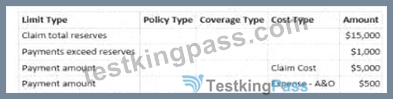
The table below is a view of the property claims organization within Succeed Insurance. The Adjuster is a member of the group Property - Team A.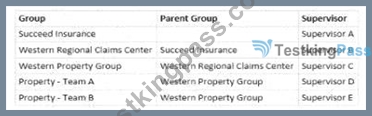
The Adjuster creates a payment in the amount of $6,500 for repairs to the insured's home. How will it be processed assuming that the claim has sufficient reserves for the payment?
- A. The payment requires approval. An approval activity will be generated and routed to Supervisor C.
- B. The payment requires no approval. It will be processed and issued to the insured.
- C. The payment requires approval. An approval activity will be generated and routed to Supervisor D.
- D. The payment requires approval. An approval activity will be generated and routed to Supervisor A.
Answer: C
Explanation:
This scenario involves checking financial Authority Limits and determining the correct Approval Routing hierarchy in Guidewire ClaimCenter.
* Check Authority Limits:First, compare the transaction amount against the user's specific limits.
* The payment is for "repairs to the insured's home," which is classified asClaim Cost(Indemnity).
* According to the provided Authority Limit Profile, the Adjuster has a "Payment amount" limit of
$5,000for Claim Cost.
* The transaction amount is$6,500.
* Since$6,500 > $5,000, the limit is exceeded, meaning the paymentrequires approval(Ruling out Option B).
* Determine Routing:When a financial transaction requires approval, ClaimCenter routes the approval activity to the supervisor of the group to which the user belongs.
* The Adjuster is a member ofProperty - Team A.
* According to the Organization chart provided, the Supervisor for "Property - Team A" is Supervisor D.
* Therefore, the system will generate an approval activity and assign it specifically to Supervisor D). Supervisor C is the manager of theparentgroup (Western Property Group), so the activity would only go to them if Supervisor Dalsolacked the authority to approve the $6,500, requiring further escalation. However, the initial routing is always to the immediate supervisor.
Why other options are incorrect:
* Option A:Supervisor C is the "Grand-boss" (Supervisor of the parent group), not the immediate supervisor.
* Option B:The amount ($6,500) clearly exceeds the defined limit ($5,000), so automatic processing is impossible.
* Option C:Supervisor A is at the top of the hierarchy (Succeed Insurance), far removed from the initial approval step.
NEW QUESTION # 36
Succeed Insurance is implementing a slightly modified version of ClaimCenter to suit its organization's needs.
The modification will include adding two new required fields to the standard user interface to capture the reporter's Preferred Language and Preferred Contact Time. This requirement is critical for Succeed to improve efficiency and the expediency of claims processing in its region.
Under which ClaimCenter theme will the User Story Card be found for documenting these requirements?
- A. Settle/Close
- B. Adjudicate
- C. Special Services
- D. Intake
Answer: D
Explanation:
In the Guidewire implementation methodology, User Stories are categorized into Themes that align with the high-level business processes of the claim lifecycle.
* Intake (Option A):TheIntaketheme covers theFirst Notice of Loss (FNOL)process and the "New Claim Wizard." The requirement specified is to capture data regarding the "Reporter" (the person reporting the loss) and their contact preferences. In ClaimCenter, Reporter information is collected at the very beginning of the New Claim Wizard (Step 1: Search/Create Policy and Reporter). Because this data entry occurs during the initial setup of the claim, the User Story governing these UI changes belongs to theIntaketheme.
* Context:Improving "expediency of claims processing" often relies on accurate data capture at the Intake stage so that downstream assignment and communication can be handled correctly from the start.
Why other options are incorrect:
* Adjudicate (B):This theme covers the investigation, evaluation, and negotiation phases that occurafter the claim is created.
* Settle/Close (D):This theme covers the payment issuance and final closure of the file.
* Special Services (C):This typically refers to Vendor Management or specialized sub-processes, not the core FNOL reporter data.
NEW QUESTION # 37
Which two components are necessary to create the check(s) using the wizard? (Choose two.)
- A. Payment tied to a reserve line
- B. Payment tied to an activity
- C. Payee
- D. Date of the claim
Answer: A,C
Explanation:
The Check Wizard in Guidewire ClaimCenter enforces strict financial integrity rules. To successfully create a check, the user must define the source of funds and the recipient.
* Payment tied to a Reserve Line (Option A):Every payment must be allocated to a specificReserve Line(combination of Exposure, Cost Type, and Cost Category). This ensures that the payment consumes the correct financial reserves and maps to the correct coverage on the policy. You cannot create a "floating" payment; it must be tied to a reserve line.
* Payee (Option C):A check is a legal instrument that must be payable to a specific entity. Selecting a Payee(from the claim contacts) is a mandatory step in the wizard.
Why other options are incorrect:
* B (Activity):While paymentscanbe linked to activities (e.g., Service Requests), it is optional. Most indemnity payments are made directly without an underlying activity.
* D (Date of claim):The Loss Date is a property of the claim, but it is not a component selected or created duringthe check wizard process. The relevant dates in the wizard are the "Service Period" or
"Scheduled Send Date."
NEW QUESTION # 38
A Business Analyst (BA) noticed that one of the User Story Card files for the project indicated that it had recently been modified. The BA wanted to see who changed it, what was changed, and why it was changed.
Where on the Story Card can the BA go to determine the changes recently made to it?
- A. Go to the Document Control tab > Amendment History
- B. Go to the Action Items tab > Description > Resolution/Comments
- C. Go to File > Properties
- D. Go to the UI Fields tab > New or Modified fields
Answer: A
Explanation:
In the standard Guidewire User Story Card template (an Excel-based tool used for requirements gathering), version control is manually tracked to ensure auditability and clarity among the project team.
* Document Control Tab (Option C):This is typically the first tab in the Story Card workbook. It contains a section specifically forAmendment History(or Revision History).
* Content:This section is designed to capture:
* Who:The author of the change.
* When:The date of the change.
* What/Why: A description of the modification (e.g., "Updated Acceptance Criteria based on Workshop feedback").
This provides the specific "Who, What, and Why" requested in the scenario.
Why other options are incorrect:
* File > Properties (A):This is standard Excel metadata. It shows the "Last Modified By" user and date, but it cannot explainwhatspecific cells were changed orwhy(the business context).
* Action Items (B):This tab tracks open questions or tasks, not the revision history of the document requirements.
* UI Fields (D):This tab tracks the requirements for screen fields, but does not serve as a changelog for the entire document.
NEW QUESTION # 39
An auto accident in Chicago, Illinois has been reported to Succeed Insurance. The customer service representative uses the ClaimCenter standard Claim Wizard to set up the new claim. The policy is verified in effect and based on the reported exposures the total loss points calculated is 38. There is also a note to have an expert inspection via approved vendor.
What is the most likely claim setup with regards to this reported auto accident?
- A. The new claim will be segmented as mid-complexity auto claim, assigned to Midwest Low Complexity Auto Adjusters Group, with activity for vehicle inspection.
- B. The new claim will be segmented as low complexity auto claim, assigned to Midwest Low Complexity Auto Adjusters Group, with activity for vehicle inspection.
- C. The new claim will be segmented as high complexity auto claim, assigned to Midwest Complex Auto Adjusters Group, with activity for vehicle inspection.
- D. The new claim will be segmented as high complexity auto claim, assigned to a Supervisor for further determination on next steps due to complexity.
Answer: C
Explanation:
ClaimCenter uses a logic-based process called Segmentation to categorize claims and Assignment to route them.
* Complexity (Points):The "Total Loss Points" score of38is significantly high. In standard configuration, high scores (typically indicating severe damage or total loss potential) trigger aHigh Complexitysegmentation.
* Assignment (Geography):The accident occurred inChicago (Midwest). The assignment rules will match the geography (Midwest) with the complexity (High/Complex). Therefore, it routes to the Midwest Complex Auto Adjusters Group.
* Workplan (Activity):The specific note regarding an "expert inspection" translates into a generated Activity(likely "Assign Vehicle Inspection" or similar) added to the claim's workplan.
Why other options are incorrect:
* A & D (Low/Mid Complexity):A score of 38 is too high for "Low Complexity" (which is usually for simple fender benders). Assigning a complex claim to a "Low Complexity" group would violate standard routing logic.
* C (Supervisor):Modern ClaimCenter configurations prefer Straight-Through Processing (STP) to a working group. Routing to a Supervisor is generally a fallback for exceptions, whereas this is a standard high-severity scenario that should go directly to the specialized adjusters.
NEW QUESTION # 40
When capturing information about a damaged vehicle, Succeed Insurance requires that the total distance driven (miles/km) for the vehicle be captured as well. What is the best practice for a Business Analyst (BA) to determine if ClaimCenter already has a field to capture distance driven?
- A. Log in to ClaimCenter and review the Vehicle Incident screen to see if there is a relevant field.
- B. Start Guidewire Studio, search for a Vehicle Incident screen and review it for a relevant field.
- C. Review the Guidewire ClaimCenter Application Guide for information on creating a vehicle incident.
- D. Check the full view of the Data Dictionary to see if a relevant field exists on the Vehicle entity.
Answer: D
Explanation:
The Data Dictionary is the definitive reference tool for Business Analysts to explore the data model of a Guidewire application.
* Best Practice:To determine if a specific data point (like "distance driven" or "odometer reading") exists in the system's schema, the BA should consult theData Dictionary. This auto-generated documentation lists all entities (such as Vehicle or VehicleIncident) and their associated fields (columns), along with data types and descriptions. This confirms existence even if the field is not currently exposed on the user interface.
* Why Option B is better than A:Checking the UI (Option A) is unreliable because a field may exist in the database but be hidden, disabled, or not placed on the specific screen the BA is viewing.
* Why Option B is better than C:The Application Guide (Option C) describes standard features and workflows but does not provide a granular, technical list of every database column, nor does it reflect any custom schema extensions added by the implementation team.
* Why Option B is better than D:While Guidewire Studio (Option D) is a powerful tool thatcanverify this, it is primarily a developer environment. For a Business Analyst, the Data Dictionary is the intended, accessible "Source of Truth" artifact for data modeling questions without requiring IDE access or technical code navigation.
NEW QUESTION # 41
An auto claim is owned by Adjuster1. The Customer Service Representative (CSR) that created the claim owns one follow-up activity on the claim. An Injury Specialist owns an injury exposure on the claim. All these persons are members of Auto Team 1.
The Team Lead determines that Adjuster1 is overworked and reassigns the claim to Adjuster2, a member of Auto Team 2.
Which three people now have access to the claim? (Choose three.)
- A. Adjuster1
- B. CSR
- C. Injury Specialist
- D. Special Investigations Unit
- E. Adjuster2
- F. The Claimant
Answer: B,C,E
Explanation:
250 to 350 words From Exact Extract of Guidewire ClaimCenter Business Analyst documentation:
In Guidewire ClaimCenter, access to a claim file is determined by Access Control Lists (ACLs), which are dynamically updated based on user roles and ownership. A user is granted access to a claim if they own the claim itself, or if they own a sub-object within that claim, such as an Activity or an Exposure.
* Adjuster2 (Option E):Upon reassignment, Adjuster2 becomes the newClaim Owner. The owner of the claim record always has full view and edit access to the claim.
* CSR (Option C):The CSR retains ownership of a specificActivity(the follow-up task). In the ClaimCenter security model, owning an open activity on a claim grants the user "view" access to the parent claim so they can perform the necessary work to complete their task. Reassigning the claim header does not automatically reassign the activities owned by other users.
* Injury Specialist (Option D):This user owns anExposure(a distinct financial sub-record for a specific coverage feature). Similar to activities, owning an exposure grants access to the parent claim. The reassignment of the main claim file from Adjuster1 to Adjuster2 does not strip the Injury Specialist of their ownership of the specific injury exposure.
Why Adjuster1 loses access:Adjuster1 was the previous owner. Once ownership is transferred to Adjuster2 (who is in a different group, "Auto Team 2"), Adjuster1 no longer meets the criteria for ownership access.
Unless Adjuster1 is explicitly added to the ACL manually or has "Super User" privileges (not stated), they lose the automatic access rights associated with being the owner.
NEW QUESTION # 42
......
Dumps MoneyBack Guarantee - ClaimCenter-Business-Analysts Dumps Approved Dumps: https://www.testkingpass.com/ClaimCenter-Business-Analysts-testking-dumps.html
2026 Updated Verified Pass ClaimCenter-Business-Analysts Exam - Real Questions and Answers: https://drive.google.com/open?id=1Ik9Vp1Mfn97tNc5iQsLIS8rs0Fq455cz